


Tuesday, Sep 15, 2026 21:45 [IST]
Last Update: Monday, Sep 14, 2026 16:16 [IST]


GANGTOK, :
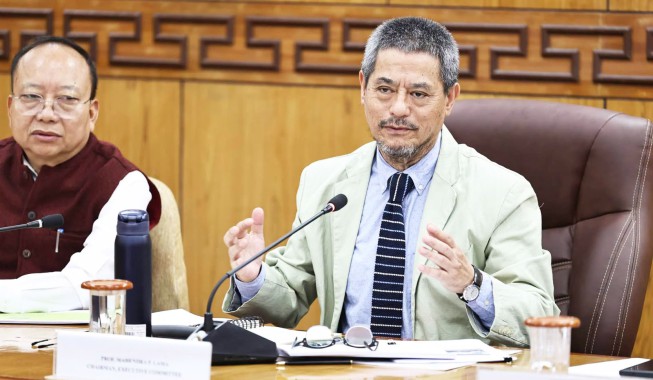
Prof. Mahendra P. Lama on Monday rejected allegations that a document outlining
possible pathways for a permanent political solution to the long-pending demand
for a separate Gorkhaland State envisaged the inclusion of Sikkim.
Lama
said the document, circulated among members of the Civil Society of Darjeeling in
July, did not contain any map or other document suggesting that Sikkim would
form part of a proposed separate State.
His
remarks came in response to what he described as "insinuating,
irresponsible and condemnable" conclusions drawn by the president of
Citizens Action Party (CAP) Sikkim while referring to the document.
The
document, titled “Road Map for a Permanent Political Solution: 4
Options/Pathways: Preliminary Discussion Draft for a Separate State”, outlined
four possible pathways – a full-fledged State as India’s 29th State, a Union
Territory, an “autonomous State” within the State of West Bengal, and North
Bengal as a State and/or the contagious areas of neighbouring States as a
separate State.
Lama
said the fourth pathway referred to a possible North Bengal State comprising
Darjeeling and Kalimpong districts, the Dooars region of Jalpaiguri and
Alipurduar districts, Chopra in Uttar Dinajpur district and other districts of
West Bengal, with the possibility of contiguous areas of neighbouring States
being included.
He
said the reference to “other contiguous States” had been “misrepresented” as
referring to Sikkim.
“The
adjoining States vary from Bihar and Jharkhand to Assam and Meghalaya,” Lama
said, adding that there was no question of seeking to dismember or dislocate
Sikkim.
Lama
said the objective of the fourth pathway was to prepare people in Darjeeling,
Terai and Dooars for the possibility of a sudden announcement by the Centre
regarding the creation of a separate North Bengal State.
He
added the document had emphasised that the constitutional status, political
representation, geographical framework, powers and functions, institutional
structures, financial devolution and administrative centres and governance
structures of the proposed separate Statemust be discussed beforehand among key
stakeholders.
According
to Lama, however, the document eventually submitted to the concerned authority
in the Centre in August contained only the first three pathways, in view of the
changing political situation in West Bengal.
The
Gorkhaland movement, Lama said, had acquired its popular identity as a movement
seeking a separate State for Indian Gorkhas and a distinct constitutional
identity, but also reflected the political aspirations, development needs and
historico-cultural concerns of several ethnic communities living in the region.
Lama
described his association with the Gorkhaland issue as a “lifelong social
commitment” and said his honorary professional position as Emeritus Chief
Economic Advisor in Sikkim should not be conflated with his involvement in the
separate-State demand.
He
accused the CAP Sikkim president of using the issue for "low-level
political propaganda" and urged him to refrain from bringing the
"gigantic and sensitive issue" of Indian Gorkha identity and separate
Statehood into the arena of domestic politics.
The Gorkhaland demand, Lama said, had been
pursued for nearly 119 years, with hundreds of people having sacrificed their
lives in the struggle for identity and Statehood.
