


Sunday, Nov 01, 2026 08:30 [IST]
Last Update: Sunday, Nov 01, 2026 02:57 [IST]


GANGTOK,: The three-day Sikkim Arts and
Literature Festival (SALF) came to a close Friday in Gangtok, bringing together
a rich confluence of literature, poetry, music and art. Celebrating the
diversity of voices, cultures and creative expressions, the festival served as
a meeting ground for acclaimed writers, poets, journalists, artists, thinkers
and cultural practitioners from across the country and beyond.
The final day, marked by thought-provoking conversations,
captivating performances, literary explorations and artistic collaborations,
carried forward the festival's spirit of celebrating stories, identities and
shared experiences. From reflections on language, migration and regional
identity to conversations on artificial intelligence, mental health,
geopolitics and women's experiences, the concluding day offered a compelling
reminder of the power of art and literature to connect communities, challenge
perspectives and inspire meaningful dialogue.
The final day's programme began with a music session, “Khamma
Ghani Sikkim: Rajasthani Folk” where Magda Khan and Group brought the rich folk
traditions of Rajasthan to the festival.
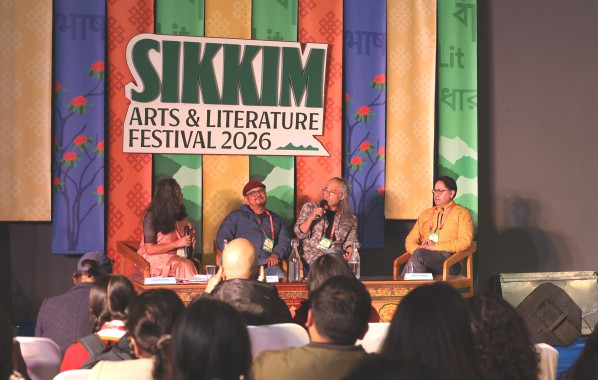
One of the highlights of the day was an engaging session
featuring renowned poet and translator Ranjit Hoskote and Sikkimese poet Guru
T. Ladakhi. The conversation touched on the topics of visual narratives through
poetry and expression of identity along with the relativity with environment
and ecology.
Discussing Hoskote’s “Jonahwhale”, the speakers talked
about migration, belonging and embracing identity. “That’s why I am drawn to
the ocean, since water has historically been unbound,” Hoskote remarked,
highlighting how the vastness of the ocean serves as a source of creative
inspiration. He further added that migration plays a significant role in the
emergence of new languages and the formation of fluid identities.
Building on this perspective, Ladakhi brought attention
to Sikkim’s historic trading routes and their relevance to migration, cultural
exchange and the movement of ideas. He noted that these routes carry their own
distinct connotations.
Hoskote read out a few lines from his poems, illustrating
the depth and colours of words that divulge into paradoxical sentiments.
Ladakhi also spoke on his own inspirations of his poems, reading a few lines
from his poem, exhibiting the unabashed appreciation of the mountains and
hills, of nature, drawing a clear picture of the landscape.
“I think it's amazing that we have literature festivals
all across the country with a variety of themes and emphasis,” Hoskote says in
appreciation for the efforts of the organisers, not only for SALF, but every
Arts and Literature Festival held in the country.
In another session, titled “The Nepali Imagination:
Between Mountains and Memory”, writers Chuden Kabimo, Prajwal Parajuly and
Shankar Deo Dhakal along with poet Sudha M. Rai, explored the enduring
influence of imagination, memory and cultural heritage on Nepali literary
narratives.
Moderated by poet and journalist Prabin Khaling, the
discussion examined how storytelling connects generations and communities
across geographical and cultural boundaries. The session also offered insights
into the contemporary realities of the Nepali language, its relevance in
society and the historical significance of stories emerging from the region.
The panellists expressed their deep attachment to the
Nepali language, and the power contained within the stories they have told.
Parajuly, author of the acclaimed works “The Gurkha's
Daughter” and “Land Where I Flee”, emphasised the need to preserve and promote
the Nepali language, pointing out that its original emotional depth and nuances
often cannot be fully captured through translation into other languages.
Dhakal spoke about the historical influences that shape
his writing, stressing the importance of documenting and bringing the region’s
past to a wider audience.
Rai, on the other hand, focused on the struggles of women
that she conveys through her poetry. She described herself as the voice of
women, especially women of this region.
The Day 3 also featured a prize distribution ceremony
where students who excelled in various competitions held over the three days
were awarded. This was followed by a musical performance by Deo Ashish Mothey.
Students of Sikkim University's English department also staged an adaptation of
Shakespeare's “A Midsummer Night's Dream”.
Technology, geopolitics and mental health featured
prominently in the day's discussions. Sessions such as “Enter Prompt: The Great
Game of AI” explored artificial intelligence and its impact on creativity and
society, while “A Borderland State of Mind” examined regional identity,
livelihoods and geopolitical realities of the Eastern Himalayas. “Conversations
for the Mind” highlighted mental health awareness, stigma and the importance of
open dialogue.
Other sessions explored sporting excellence, women's
experiences, cultural storytelling and creative expression. “The Making of a
Champion” reflected on the discipline and perseverance behind sporting success,
while “A Woman's World” brought women's voices and perspectives to the
forefront. Poetry and performance came together in “Kavita Concert: Beats of
Poetry”, while “The Poetic Imagination” celebrated poetry as a medium of
reflection and creativity. White Memorial Hall also hosted sessions on storytelling,
illustration and visual narratives.
The day further featured book launches by Guru T.
Ladakhi, Charmi Chheda, Shubhra Saxena and Maria Denjongpa, alongside workshops
on expressive arts and Rajasthani folk music led by Puneeta Roy and Magda Khan
and Group.
The ‘Sound of Souls x Gauransh’ concert brought the
celebrations to a musical close.
