


Saturday, Oct 31, 2026 22:30 [IST]
Last Update: Friday, Oct 30, 2026 16:53 [IST]


NEW DELHI, (IANS): The Central Bureau of
Investigation (CBI) has told the Supreme Court that there is every likelihood
of former judge Giribala Singh influencing the trial proceedings and
intimidating witnesses in the case relating to the death of former model and
actress Twisha Sharma, supporting the plea seeking transfer of the trial from
Bhopal to Delhi.
In a counter-affidavit filed before the apex court, the
probe agency said Giribala Singh, a retired Principal District and Sessions
Judge, was an influential person in Bhopal and could potentially affect the
fairness of the proceedings pending before the Sessions Court. "Respondent
No. 2 Giribala Singh may influence the trial proceedings of the case and
intimidate the witnesses of the case," the CBI stated in its affidavit.
The counter-affidavit was filed in response to a transfer
petition moved by Twisha's father, Navnidhi Sharma, seeking transfer of the
criminal trial pending before the Court of the Xth District and Sessions Judge,
Bhopal, to a competent court in Delhi.
The CBI further submitted that Giribala Singh, who had
served as a District Judge and was holding the post of President of the
District Consumer Disputes Redressal Commission, Bhopal, at the time of the
incident, could influence the trial proceedings owing to her position and
connections.
The probe agency also highlighted that her son, Samarth
Singh, who is the deceased's husband and a co-accused in the case, is a
practising advocate in Bhopal.
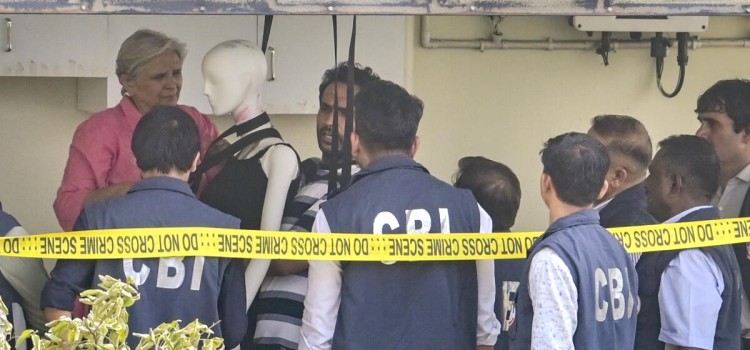
Referring to the investigation, the CBI claimed that
Giribala Singh had interfered with the handling of evidence following Twisha's
death and attempted to manage the crime scene and tamper with evidence.
The affidavit stated that the investigation had
established that Giribala Singh called a technician and obtained copies of CCTV
footage relating to the relevant period. It further stated that on May 13,
2026, she contacted the owner of Xpression Beauty Parlour to enquire about
Twisha's visit on the previous day and arranged for the relevant CCTV footage
to be collected through certain persons.
The CBI said these circumstances, along with her position
as a former District Judge, raised concerns about the possibility of her
influencing the trial and intimidating witnesses.
Twisha was found hanging at her matrimonial home in
Bhopal on the night of May 12, 2026, and was declared brought dead at AIIMS
Bhopal. Following the incident, an FIR was registered at Katara Hills police
station against her husband Samarth Singh and mother-in-law Giribala Singh
under the provisions of the Bharatiya Nyaya Sanhita (BNS) and the Dowry
Prohibition Act, alleging cruelty and harassment over dowry.
The Madhya Pradesh government subsequently transferred
the investigation to the CBI, which re-registered the case on May 25, 2026,
following the Supreme Court's suo motu cognisance of the matter. The probe
agency said it filed a chargesheet against the two accused on August 17, 2026,
for offences punishable under Sections 85, 108 and 3(5) of the BNS, while
further investigation concerning dowry death, dowry and other aspects was
continuing.
It added that the trial court had taken cognisance of the
offences and the proceedings had reached the stage of arguments on framing of
charges, with the next hearing scheduled for October 31.
The Supreme Court had earlier, on October 16, stayed the
ongoing trial before the Bhopal court and issued notices to the CBI, Giribala
Singh and Samarth Singh on the transfer petition filed by Navnidhi Sharma.
The deceased’s father has expressed apprehension that his
daughter would not get a fair trial in Madhya Pradesh, citing the influence
wielded by her mother-in-law and concerns over the handling of the initial
investigation and bail proceedings.
On Friday, a Bench of Chief Justice of India (CJI) Surya
Kant and Justices Joymalya Bagchi and V. Mohana adjourned the hearing in the
matter. The transfer petition is tentatively listed for November 19, as per the
computerised case status available on the Supreme Court's website.
