

Tuesday, Oct 13, 2026 23:15 [IST]
Last Update: Monday, Oct 12, 2026 17:35 [IST]


GANGTOK,:
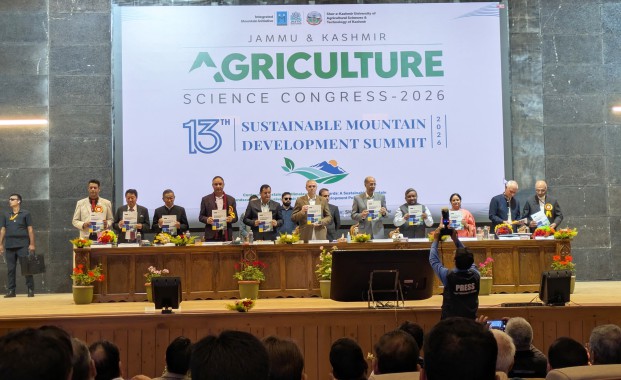
The 13th edition of the Sustainable Mountain Development Summit began in
Srinagar on Monday, with policymakers, community representatives, practitioners
and academics deliberating on challenges facing the Himalayan region and the
need for sustainable development.
Jammu
& Kashmir Chief Minister Omar Abdullah inaugurated the summit, a flagship
initiative of the Integrated Mountain Initiative (IMI), hosted this year by
Sher-e-Kashmir University of Agricultural Sciences and Technology of Kashmir
(SKUAST-K) at its Shalimar campus.
Addressing
the inaugural session, Abdullah said people were increasingly becoming
insensitive to the mountains and their ecological needs.
“Pahad
ko khayal nahirakhtey,” he said, stressing the need for collective
responsibility in protecting the fragile Himalayan ecosystem.
Referring
to the recent disaster in Nepal, the Chief Minister said climate change was a
global issue requiring international negotiations, while its adverse impacts
were being experienced directly by mountain communities.
He
cited changing snowfall and rainfall patterns in Jammu & Kashmir, which had
contributed to drought conditions in some areas and heavy rainfall-related
disasters in others.
Abdullah
also questioned road construction practices involving extensive slope cutting,
saying they contributed to landslides. On tourism, he said the tendency to
blame tourists alone for littering and unsustainable practices needed to be
reconsidered, as local residents also had a responsibility to adopt
environmentally conscious behaviour.
He
expressed hope that the summit would produce actionable roadmaps to address key
challenges facing the mountains.
IMI
councillor Dr. R.Kotru outlined the objectives of the summit, saying it sought
to bring together scientific knowledge, policymaking, grassroots experience and
practitioners to develop informed and innovative responses to emerging mountain
challenges.
Sharing
the vision of IMI, former IMI president P.D. Rai said theorganisation worked
towards making India proud of its mountains, mentioning that the IMI’s mission
was to inform policy that were mountain sensitive. IMI focused on creating a
platform for all stakeholders, integrating knowledge and experience, and
generating action on ground, he stated.
Rai,
the former Lok Sabha MP from Sikkim, added that previous editions of the summit
had addressed a wide range of mountain-related issues and that their outcomes
had helped inform policies and decision-makers.
IMI
president Dr. S.T.S. Lepcha presented the objectives and themes of the 13th
edition, which include ecological security and climate resilience, ecological
carrying capacity, responsible tourism and the mountain economy, mountain
communities, livelihoods and natural capital, and science, governance and
policy.
He
said the outcomes would be taken forward through IMI's state chapters across
the Indian Himalayan Region.
SKUAST-K
vice-chancellor N.A.Ganai questioned the prevailing development trajectory of
Himalayan states and called for an overarching sustainable mountain policy.
He
said a policy for Jammu & Kashmir, aligned with global climate concerns,
biodiversity priorities and disaster-related protocols and agreements, was
being drafted.
The
proposed document covers tourism, infrastructure, water, waste management,
forests, livelihoods and knowledge, and could serve as a model for other states
in the Indian Himalayan Region, he said.
Mandeep
Kaur, secretary of Jammu & Kashmir Urban Development department, stressed
the need for communities to develop sustainable urban habitats in the Himalayas
amid rapid urbanisation.
Rural
Development minister Javed Ahmed Dhar drew attention to the increasing
frequency of disasters across the Himalayan region, noting that many incidents,
particularly in remote areas with limited media and communication access,
remained underreported.
During
the inaugural session, Abdullah released the report of the 12th Sustainable
Mountain Development Summit, held in Dehradun in 2025, along with other reports
published by SKUAST-K.

