Thursday, Jan 08, 2026 22:00 [IST]
Last Update: Wednesday, Jan 07, 2026 16:22 [IST]


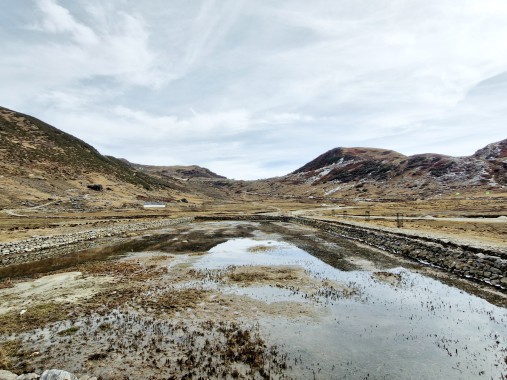
GANGTOK, : Sikkim is in the works to become the first State in the Northeast to
introduce ice hockey as a winter sport, with plans underway to set up a natural
ice rink at Gnathang Valley in East Sikkim, expected to become operational from
next winter.
The
initiative, led by Gangtok DC Tushar G. Nikhare and a brainchild of Sikkim
Mountaineering Association (SMA) president Kunzang Gyatso Bhutia, in
coordination with the Sports department and the Ice Hockey Association of India
(IHAI), aims to develop Gnathang into a winter sports hub, combining youth
sports development with winter tourism and positioning Sikkim alongside regions
like Ladakh and Himachal where the sport is already played.
In
the last week of November 2025, an IHAI team comprising general secretary
Harjinder Singh, an Indian coach with an engineering background for technical
work, and a director from Ladakh visited the high-altitude region of Gnathang
Valley for a recce, accompanied by Kunzang Gyatso. The visit was conducted in
coordination with Gangtok DC Tushar G. Nikhare and the Sports department.
Following
the recce, the IHAI has submitted a report on the visit to Sikkim. The IHAI has
assessed the proposed natural ice rink at Gnathang Valley as “highly feasible”
for the introduction of ice hockey.
“The
location already has a prepared base surface suitable for freezing into an ice
rink, and the natural temperature profile supports sustained operations during
winter,” the team reported, adding that a weather-resistant roof would be
essential to protect the ice from sunlight and snowfall and extend play hours.
The association also recommended modular dasher boards for player safety and
compliance with ice hockey standards, along with temporary changing rooms,
storage, first-aid facilities, and a small spectator stand to promote public
participation and winter tourism.
The
proposal outlines a phased implementation plan, beginning with roof
construction and utilities, followed by rink finishing and installation of
dasher boards, and finally the development of spectator and support facilities.
Routine ice maintenance would involve thin-layer flooding using portable pump
systems, snow clearance, and daily upkeep to ensure a smooth playing surface.
The
IHAI has also recommended the formation of a State Ice Hockey Association in
Sikkim and its affiliation with the IHAI to enable technical coordination,
infrastructure support, and access to national-level training pathways.
“Affiliation will help streamline knowledge sharing, equipment support, and
future player development,” the report noted.
Speaking
to SIKKIM EXPRESS, Kunzang Gyatso said the vision goes beyond a single sport.
He informed that the project is being developed in consultation with the
Gangtok DC, under the Sports Department’s adventure cell.
“We
should view winter from two angles, as winter sports and as winter tourism, so
we can have tourism flow and sports activities all year long. That’s why we
chose Gnathang, the nearest and most suitable place for winter sports. Gnathang
was selected after assessing transportation, connectivity, terrain, and winter
temperature conditions. Gnathang is already promoted as a tourism destination
by government departments. If we set up an ice hockey rink there, it will make
the place even better,” said Bhutia.
The
IHAI officials said Gnathang is very feasible with good transport, land, and
accommodation. The only challenge is that since it is open, a roof is needed so
the ice does not melt fast and children can play longer. Natural ice had
already formed in November, and experts had termed the site “very good,” noting
that Sikkim’s winter conditions allow longer playing hours compared to several
other Himalayan states, he added.
The
organisers plan to begin with low-budget infrastructure and expand in phases
once proposals and funding are finalised. The natural season, they said, could
run from the end of December to the end of February, and possibly up to
mid-March with a shed over the rink.
Kunzang
stated that the project could create pathways for athletes to compete at
national and international levels.
“Sports
give our youth a framework to go forward. Just like Manipur is known for Mary
Kom or Assam for boxing, I hope Sikkim kids playing ice hockey will one day
reach the Olympics and put our State on the map,” he said.
He
added that the effort would also generate economic opportunities for local
residents. “Once one winter sport starts, more publicity comes. Tourism
department can add carnivals or festivals. For locals who depend on seasonal
tourism, events mean business from participants, coaches, and families. In the
long term, like South Korea or China hosting winter events, we could one day
host national or international competitions.”
The
team is also coordinating medical backup support with nearby health centres and
the Indian Army’s high-altitude training facility, with the possibility of army
personnel participating in training programmes, as in Ladakh.
IHAI general
secretary Harjinder Singh said ice hockey as a sport is expanding rapidly
across Himalayan regions and Sikkim has strong natural advantages.
“Ice
hockey is a Winter Olympic sport and very suitable for our Himalayan region,
where youth often have little to do in the winter months. Wherever natural ice
forms, people can play, and here in Sikkim, natural rinks can be made at a much
lower cost.”
He
said the federation’s vision is to spread the sport across India, combining
natural and artificial rinks, as seen in countries like Canada and across
Europe.
“We
want more people in our country to play ice hockey. We will provide technical
support for rink building and coaching. If concerned departments come together,
Sikkim can become a model State for winter sports,” Singh said.
He
added that beginners typically learn to skate and balance within 10–15 days,
with strong progress visible in two to three months. The federation has also
offered to train two children from Sikkim as future coaches at its facility.
Ladakh-based
national player and coach Gulaam Mustafa, who was part of the technical team,
said Sikkim’s terrain and climate closely resemble early-stage ice hockey
environments in Ladakh.
“I
started playing on a similar kind of rink when I was 12, and today I’m in the
national team and coaching youth hockey in Ladakh. Once you start, you keep
improving with patience and time. The atmosphere and culture here feel very
similar to Ladakh. I think people will love the game and adapt to it very
well,” he said.
Kunzang
Gyatso said the initiative had been in discussion for nearly three years and
was now close to taking shape with the DC’s support. “We have done two or three
recces already and also invited IHAI for technical guidance. We are working
closely with the administration to complete technical reports, cost estimates,
and equipment proposals, with plans to begin training children aged 5–12, who
pick up the sport fastest.”
Eventually,
the team aims to build an indoor artificial rink for year-round play and
attract children not only from Sikkim but also from other States, making Sikkim
a pioneer of winter sports in the Northeast, with support from Ladakh.
The
IHAI has also indicated that national winter training camps could be possible
in Sikkim within the next two to three years.
This
initiative is expected to open opportunities for youth participation in
national-level winter sports while generating seasonal economic activity for
local communities.