Friday, Nov 14, 2025 22:45 [IST]
Last Update: Thursday, Nov 13, 2025 17:05 [IST]


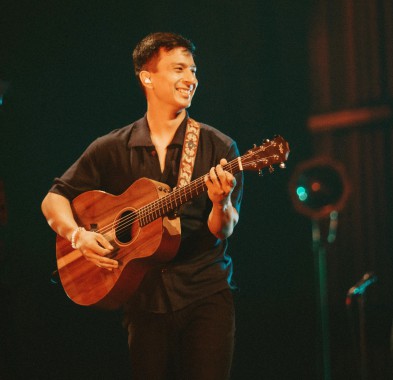
GANGTOK,: Gangtok is about to ‘Get Loud!’ this weekend, as one of Nepal’s most loved singer-songwriters, Sajjan Raj Vaidya, arrives for what promises to be one of the biggest live music nights Sikkim has ever seen.
Fresh from a sold-out concert in Siliguri, Sajjan was warmly welcomed at Rangpo on Monday by KStars Entertainment along with chairman Sanjay Dilpali Rai. His “Let’s Get Loud India Tour 2025” now makes its much-awaited Sikkim stop at Tadong College Ground this Saturday, where more than 5,000 fans are expected to gather under the open sky.
The India Tour has been curated and bought by PVE Network, a company based in Kathmandu, Nepal, which is also officially registered in India. PVE Network owns the registered intellectual property “LET’S GET LOUD INDIA,” under which this concert series is being executed.
The Siliguri concert was executed in association with Club Gravity as the regional partner, while the Gangtok edition has been organized in collaboration with KStars Entertainment for Sikkim.
Fans will also get a chance to meet Sajjan in person at West Point Mall, where he will make a special appearance at 4:30 p.m. on Friday. The organisers have encouraged fans to arrive early to avoid the rush.
Excerpts from an exclusive interview with SIKKIM EXPRESS
You have been in Gangtok for a few days now. How have you been spending your time here?
Sajjan: We’ve been mostly resting and planning a lot for the show. We have a few music video ideas we’ve been working on for some upcoming releases. The entire team is here, and everyone’s recovering and preparing for the performance. So, it’s been a lot of logistics and planning.
We visited MG Marg too. Every city has a central heart. For us in Kathmandu, it’s Basantpur or Bhaktapur Square. For Gangtok, it’s MG Marg!
MG Marg reminded me of London. When we first went there, we just walked around, and it was quite nice. The landscape here is so unique. I wasn’t sure at first how people would gather in a place like that, but it’s fascinating, very lively and full of energy! I can see why everyone talks about MG Marg so much. It’s definitely a happening spot, and I really enjoyed it.
This is your first India tour, and you recently performed in Siliguri. How was your experience performing for the crowd this side?
Sajjan: Oh, it was absolutely fantastic! When we think about audiences, you can usually tell which crowds are true music lovers; the kind who listen to all the classics, not just the popular ones. In Siliguri, everyone seemed to be singing every word, every line. When we asked them to listen, they actually listened. It felt like it was all about the music, not just the hype.
It was a beautiful experience because the crowd was so warm, loving, and fully involved. It’s definitely prepared us for Sikkim even more because when you receive this kind of encouragement, it stays with you. We’re hoping the Sikkim show will be as good as Siliguri, maybe even better.
So, why did you choose Sikkim, and what are your expectations from the crowd here?
Sajjan: Sikkim feels a little bit like Pokhara for us. The crowd here loves music, and people come to live shows for the music itself. There’s nothing wrong with people coming for the hype and to experience what others have described as a great show. But when you come for the music, it becomes a two-way connection, and that’s very special.
We’re hoping the Sikkim crowd will respond the same way and that they’ll sing with us and be as loud as possible. While there’s only one name at the front, there are so many people who make it happen. Our light designer, who’s just 21 or 22, is creating the light show the audience sees. Pratik is managing everything behind the scenes. Then there’s our full band (about nine to eleven members) and the sound engineer.
I really hope people will appreciate not just the name they see on stage, but also everyone (crew, band, etc.) who work to bring the performance together. We’ve put a lot into this show, and I hope the crowd enjoys every part of it. Hopefully, it’s something they’ll like. We’re really excited.
One of the great things about our Nepali core is that sense of connection among everyone, which makes us feel at home wherever we go. Whether it’s London, New York, Sydney, or here, we still feel the same warmth. So, in a very beautiful way, it’s not different. Everyone is just as enthusiastic and full of love. There’s a strong sense of identity when Nepalis come together, especially for music. It’s absolutely wonderful!
New music releases as part of the Sikkim–Siliguri tour.
Sajjan: We’ve been told, and we’ve also seen for ourselves, that Sikkim has so many different landscapes and stunning locations. We really want to make use of that.
Any emotion we try to express through music, I know the visuals here will only emphasize it even more. So, we’re hoping to find the places we’ve been imagining, and if it comes together, I think it’s going to look absolutely gorgeous. I have full faith in my team and they’ll pull it off!
As a musician, what is your creative process?
Sajjan: The beauty of it is that there’s no single approach. There are so many avenues to go through, so many veins you can follow. To simplify, it really comes down to inspiration.
For me, the inspiration either comes from my own life experiences or from someone else’s story. It’s basically storytelling! Every time I come across a story that’s even mildly captivating, that’s where it begins.
For ‘Suskera’, the song we just released, it was all about the vibe. It’s about being romantic without making it entirely about love. Just feeling good, happy, and lighthearted!
For the one we’re working on now, it’s more sincere, deep, and circumstantial. So, when we start putting things together, I think about the theme: is it happy, sad, heavy, or light? Once that’s clear, it’s like painting a picture and you just start drawing it out.
The great thing about music is that inspiration can come from anywhere. It can be words, melody, people or even things that have nothing to do with music. It’s all interconnected, and we’re lucky to find inspiration in so many places.
Your music is a mix of modern and Nepali roots. How did you develop that style?
Sajjan: I was introduced to Nepali music through my parents, my family, and my brother. Whenever we listened to music, we’d be at home in the kitchen, singing along to everything.
My father listened to pop, reggae, classic rock, and classic pop. So we had Bryan Adams, Guns N’ Roses, UB40, Michael Learns to Rock, etc.
My mother used to listen to old artists like Deep Shrestha, Aruna Lama, Karna Das, and others. They all had such deep and sophisticated Nepali vocabulary.
My brother introduced me to newer ones like Gorillaz, Red Hot Chili Peppers, Linkin Park, and John Mayer; who I’d say is the artist my style is most based on. I was fortunate enough to have all these different influences to draw from.
At the same time, I’m a product of a generation that mostly uses colloquial Nepali rather than those deep, traditional words. So, it naturally became a mix of both, with a bit of Western influence in how one expresses things. And that’s the beauty of language, right? You learn how people speak, what tones they use, what they mean when they say certain things.
It’s an amalgamation of everything: a little bit of old songs, old films, and a little bit of the new ones too. Everything just came together that way.
Since your early music like ‘Hawaijahaj’ and others, how do you think your music has evolved over the years?
Sajjan: I think the evolution of my music comes down to incorporating styles that I’m trying to learn. One of the things about me is that I don’t listen to just one type of music.
On a regular day, I’ll go from classical Nepali music to System of a Down, and on another day, I might just listen to Ariana Grande. So I try to listen to every kind of music. And in every genre or style, there’s always that one thing I think: “Okay, I wish I could do this.” Then I try to learn it, sometimes I add it in, and sometimes it works, sometimes it doesn’t.
I feel like my music has evolved into a sort of obscure genre where everything fits in. For instance, ‘Chautari’ has a lot of electronic influence, but at the same time, it carries strong classical Nepali elements too.
So yeah, more genres and more experimentation have come into play.
What’s next?
Sajjan: We’re always going to try to push harder, bring more music, maybe with more variations and complexity, hopefully something that signifies growth. We want to do bigger shows, release songs that are more complex or more connective, and hopefully make videos that are larger, maybe even cinematic. Just bigger things, and more of what we already love doing.
Message to your Sikkim fans
Sajjan: To all the fans, supporters, and everyone who’s ever listened to our music, I just want to say thank you so much. Every time we play a show, we’re truly grateful. And it’s not just something we say to make everyone feel good. We actually feel it!
Just as people give so much love to the name in front, I hope they also recognize how much work goes on behind everything: the lights, the costumes, the stage, the logistics. It’s an art form in itself. I hope people learn to appreciate that as well. I’m sure they will, in time.
PVE Network: Redefining South Asian Entertainment
Founded in 2006 by Bikesh Kayastha in Kathmandu, Positive Vibes Entertainment (PVE) Network has grown into one of South Asia’s most dynamic entertainment companies, revolutionizing live music, cultural events, and brand experiences. Initially focused on social awareness programs in India and Nepal, it shifted to large-scale commercial entertainment in 2011 and has since executed over 300 events across 40+ global cities, including collaborations in Nepal, India, Australia, the USA, South Korea, and the UAE.
With partnerships spanning 50+ artists, 150+ venues, and major global brands like Surya Nepal Pvt. Ltd., Coke Zero, Smirnoff Vodka, and Tesla, PVE has built a reputation for innovation and reliability. Key milestones include Nepal’s first restaurant-bar artist tour, managing Nepathya’s Kathmandu concert post-Wembley, producing their 25th Anniversary Concert in Pokhara, organizing the country’s largest post-pandemic open-air concerts, and leading the Fulbari (2023)national promotional tour.
Guided by a mission to uplift Nepali talent globally and foster cross-cultural creativity, PVE continues to pioneer landmark events and brand integrations that unite audiences through entertainment, innovation, and storytelling.
The Let’s Get Loud India Tour 2025 team: Under the leadership of Founding Director Bikesh Kayastha, the PVE Network core team has been actively working behind the scenes in Gangtok for over three months to bring this monumental event to life.
Key members:
1. Bikesh Kayastha - Founding Director
2. Steve Dewan - Project Manager
3. Marketing Head - Rohit Shrestha
4. Content Creator - Sanjit Tamang
5. Sanjiv Prakash Shrestha - Ticketing In-Charge
6. Operational Manager - Samit Shrestha
7. Architect & Plot Manager - Divya Maharjan
8. Marketing Head - Rohit Shrestha
+7 additional production and creative team members, who are currently stationed in Gangtok, overseeing the on-ground execution for Sajjan Raj Vaidya Live: Let’s Get Loud Sikkim 2025.