Friday, May 29, 2026 08:30 [IST]
Last Update: Friday, May 29, 2026 02:57 [IST]


PAKYONG, (IPR):
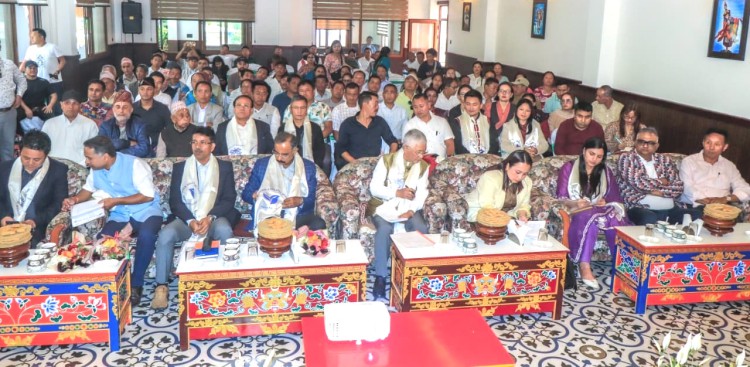
Member of Parliament (Rajya Sabha) D.T. Lepcha, in the presence of area MLA
Pamin Lepcha, attended the Tea Growers’ Meet held at Pakyong today.
Organised
by Tea Growers’ Welfare Board (TGWB), Gnathang-Machong, the meeting aimed to
discuss key issues and developmental aspects related to tea cultivation in the
region, while focusing on the welfare and empowerment of local tea growers.
Addressing
the gathering, D.T. Lepcha expressed his gratitude to the dignitaries from the
Tea Board of India for visiting the region and extending guidance and
assistance to small tea growers, further mentioning that the development of tea
plantation in the state is a dream project aimed at creating sustainable
livelihood opportunities
Stressing
the potential of tea tourism and township development, he stated that the
region is expected to witness immense growth in the coming years, which would
benefit the local population economically, and urged the attendees to take
individual responsibility for maintaining and protecting the plantation areas.
He further advised the tea growers to obtain the mandatory QR-based identity
cards for small tea growers to avail its benefits and assistance.
Additionally,
the Rajya Sabha MP emphasised the importance of the Special Intensive Revision
(SIR) initiative and stated that no genuine beneficiary should be left out. He
then appealed to the concerned officials and public to extend full cooperation
for the smooth and effective implementation of the initiative.
MLA
Pamin Lepcha stated that tea cultivation holds immense potential in the region
and with technical expertise and institutional support, it can emerge as a
successful and sustainable tea-growing belt in the years to come. She mentioned
that the initiative is not solely about tea cultivation but is a tool to
empower rural empowerment, create livelihood generation and bring economic
development.
She
then highlighted the need for awareness on various government schemes and
capacity-building support for the tea growers and requested the Tea Board to
organise regular awareness camps, field demonstrations and training programmes
in the region to equip the growers with necessary knowledge.
The
MLA appealed for the formation of tea growers’ collectives, cooperatives and
regional branding mechanisms assistance in areas such as marketing, quality
assurance, organic certification, packaging, branding and market linkages to
enhance market access, branding value and long-term sustainability.
She
stated that approximately three acres of land have already been identified and
the acquisition process is currently underway and informed that the
establishment of the local tea factory would represent a major milestone for
the growers.
S.
Soundararajan, director of Tea Development, Tea Board India, Kolkata Head
Office, commended the initiatives undertaken for the development of the region,
stating that such efforts contribute to socio-economic development while
playing a crucial role in empowering the rural communities.
He
underscored the importance of prioritising the production of high-quality tea
over quantity and assured to provide continued support through quarterly
workshops aligned with the tea cultivation seasons, along with institutional
training programmes for workers to enhance their understanding of scientific
tea cultivation practices and effective management techniques.
Kamal
Ch Baishya, executive director of Tea Development, Tea Board India, Siliguri
(Zonal Office), informed that the tea cultivation is an eco-friendly and
sustainable sector with immense potential for the region and informed that the
Tea Board of India has been working towards the overall development of the tea
industry for over seven decades through various schemes and financial
assistance programmes with emphasis on supporting small tea growers.
He
stressed the importance of focusing on quality tea production, particularly
organic and orthodox tea, considering the favourable agro-climatic conditions
of the region, further advising the growers to carefully select high-quality
planting materials and suitable tea varieties to ensure long-term
sustainability and better market value. Discussions were also held on financial
assistance, subsidy schemes, cultivation practices, factory establishment and
marketing strategies for small tea growers.
In
addition, a brief presentation was delivered on the guidelines, assistance
schemes and eligibility criteria for SHGs and small tea growers. The
presentation highlighted measures under SCSP/TASP, support for organising small
tea growers through FPOs/FPCs, capacity-building programmes including
workshops, seminars, and institutional training on GAP and GMP, health
awareness camps for ST workers and educational support for the wards of big tea
garden workers and small tea growers owning up to 1 hectare of land.
Furthermore,
TGWB president Kamal Kafley highlighted on the history of tea plantation in the
region and expressed his gratitude to the Rajya Sabha MP for facilitating
opportunities aimed at promoting self-sustainability and expanding tourism in
the area. He also addressed on the challenges and accomplishments of the
organisation, further outlining on its future vision and objectives.
Earlier,
D.T. Lepcha accompanied by officials from the Tea Board of India and Tea
Growers’ Welfare Board (TGWB), conducted an inspection of the tea plantation
site. During the visit, he interacted with the officials and enquired about the
region’s potential for tea cultivation, existing challenges and opportunities
for market expansion.
The
officials shared insights and practical suggestions on improving tea quality,
adopting better cultivation and processing practices to create stronger market
linkages and better opportunities for local tea growers.
Also
present were panchayat presidents, officials from various line departments and
tea growers from different regions.