Friday, May 08, 2026 15:00 [IST]
Last Update: Friday, May 08, 2026 09:27 [IST]


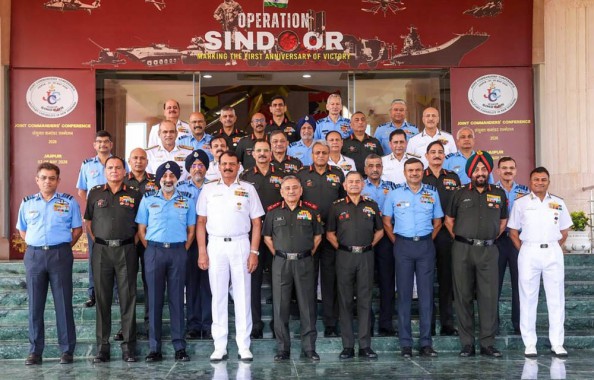
JAIPUR, (IANS): Marking the first
anniversary of Operation Sindoor, India’s top military leadership gathered at
the South Western Command in Jaipur on Thursday and delivered a strong message
against terrorism, declaring that the operation represented not an end, but the
beginning of a new strategic resolve.
Addressing a joint press
conference, senior officers from the Army, Air Force, and Navy said India would
continue taking decisive action to safeguard national security and prevent
terror attacks like the Pahalgam incident from recurring.
The briefing was attended by senior
military officials, including Deputy Chief of Integrated Defence Staff Lt Gen
Zubil A. Minwalla, Lt Gen Rajiv Ghai, Air Marshal Avdhesh Kumar Bharti and Vice
Admiral A.N. Pramod.
Defence Minister Rajnath Singh
is also scheduled to attend the anniversary event later in the day. Speaking
during the conference, Lieutenant General Rajiv Ghai said Operation Sindoor
demonstrated that India’s fight against terrorism would continue relentlessly.
Referring to the country’s
growing military self-reliance, he stated that nearly 65 per cent of the
weapons currently used by the armed forces are now manufactured domestically.
Lieutenant General Rajiv Ghai said, “Pakistan lost more than 100 soldiers
during Operation Sindoor, while over 100 terrorists were killed in the nine
terrorist camps targeted by India. A list of honours and awards that later
surfaced online showed that many of those awards were posthumous.”
Taking a swipe at Pakistan’s
narrative warfare, Ghai remarked, “If Pakistan had invested as much in strengthening
its combat capabilities as it does in propaganda and narrative building, its
performance would perhaps have been much better.”
Referring to the broader
message of the operation, he said, “Operation Sindoor made it clear that no
terrorist base in Pakistan is safe anymore. India will continue its fight
against terrorism and will take every necessary step to ensure its security.”
Ghai stated that during the
operation on May 7, 2025, seven targets were engaged by the Indian Army and two
by the Indian Air Force.
Speaking about the ceasefire
that followed, he said, “After suffering heavy losses, the opposing side came
to its senses and sought a ceasefire. When that request came, we halted
operations. We stepped back, but we did not show weakness.”
“We had delivered our message,
and that message was clear: any act of aggression would invite a retaliatory
response, and terrorism would come at a cost,” he added.
“Operation Sindoor is not over
yet; it is just the beginning,” he remarked, while quoting poet Dushyant Kumar:
“My aim is not merely to create noise, but to change the situation
(Sirfhungamakarnameramaksadnahin, meri koshishhai ki
sooratbadalnichahiye)".
Air Marshal Avdhesh Kumar
Bharti described the Pahalgam terror attack as a painful national tragedy,
saying, “We cannot bring back our brothers and sisters who lost their lives,
but we can ensure that such an attack never happens again.”
He emphasised that the armed
forces were given complete operational freedom during Operation Sindoor and
that every strategic decision was taken jointly by the Army, Navy, and Air
Force leadership. “When our desire for peace is mistaken for weakness, we have
no option but to act. And when we act, there is no room for leniency,” he said.
He also addressed questions regarding the ceasefire decision and India’s
response to terrorism.
“A question that repeatedly
arises is why we agreed to cease hostilities. I fully understand the anger and
emotions of our people, especially the younger generation, given our past
experiences with Pakistan,” he said.
Clarifying India’s position,
the Air Marshal stated that the operation was aimed specifically at terrorists
and their support infrastructure. “Our fight was against terrorism and the
ecosystem supporting it. We targeted only those elements while ensuring there
was no collateral damage or civilian casualties. We achieved our objectives and
successfully completed our mission,” he said.
He further added that the
situation escalated when the Pakistani establishment chose to back terrorist
elements. “At that point, it was no longer merely a counter-terrorism
operation; it became an act of self-defence. Our response was firm, lethal, and
extremely harsh,” he said.
According to him, following
significant losses, Pakistan sought a ceasefire. “Once the request for a
ceasefire came, we halted operations. We stepped back, but that should not be
mistaken for weakness,” he asserted.
Emphasising India’s stance, he
concluded, “Our message was loud and clear, any act of audacity will invite a
strong response, and terrorism will come at a cost.”
The Air Marshal further claimed
that the operation successfully destroyed nine terrorist hideouts inside
Pakistan and Pakistan-occupied Kashmir (PoK), damaged 11 airfields, and shot
down 13 aircraft, while ensuring that no damage occurred to Indian civilian or
military infrastructure.
Vice Admiral A.N. Pramod said,
“The operation showcased ‘JAI’, Jointness, Atmanirbharta, and Indigenisation.”
Speaking on Operation Sindoor,
he said, “The operation witnessed seamless integration of the three services,
including regular meetings among the Director Generals of all three services.
Controlled escalation response and quick decision-making enabled better action
on the ground.”
He further stated,
“Synchronised military action against the adversary and seamless coordination
with all agencies ensured the robust employment of comprehensive national
power.”
Highlighting the importance of
self-reliance, the Vice Admiral said, “Atmanirbharta proved to be a critical
enabler for operational success.”
“I would like to assure the
citizens of Bharat that the Indian Armed Forces, including the Indian Navy,
remain ready and forward deployed,” he added.
Referring to India’s military
preparedness, he said, “If Operation Sindoor was proof of calibrated resolve,
our next response will be about sustained overmatch. If challenged again, we
will not merely respond; we will shape the battlespace from outside.”
“The Indian Navy, alongside the
Indian Army and the Indian Air Force, has the capability to strike deep, far,
and with precision, anytime, anywhere, anyhow,” Vice Admiral A. N. Pramod said.
Lt Gen Zubin A. Minwalla said,
“The success of Operation Sindoor is firmly rooted in the reforms initiated by
the government, including the creation of the post of Chief of Defence Staff
(CDS). These reforms translated into operational success.”
He added, “The operation was
supported by a robust communication architecture, and this architecture is
continuously being strengthened.”
“We are working towards an
integrated and layered architecture to ensure seamless protection against
multiple threats and vectors, including drones and missiles,” he said.
Highlighting ongoing
modernisation efforts, Lt Gen Minwalla stated, “A key pillar of our progress is
the strengthening of command and control structures. A gradual transformation
from a network-centric to a data-centric architecture is underway.”
On India’s space capabilities,
he said, “In the space domain, close coordination with ISRO and the Department
of Space is enhancing real-time capabilities.”