


Saturday, Nov 07, 2026 21:45 [IST]
Last Update: Friday, Nov 06, 2026 16:07 [IST]


GANGTOK,: The High Court of Sikkim has called for urgent measures to
strengthen the State’s preparedness against Glacial Lake Outburst Floods
(GLOFs), urging the State and Central governments to immediately move towards
installing early warning systems to avert a disaster similar to the one that
struck the State in October 2023.
Sikkim
has 40 high-risk glacial lakes as listed by the National Disaster Management
Authority (NDMA). The Himalayan State
along with Teesta River downstream areas of North Bengal suffered extensive
damage during the 2023 GLOF.
During
the hearing on thesuo motu PIL on climatic justice in Sikkim on November 5, the
division bench of Chief Justice A. Muhamed Mustaque and Justice Bhaskar Raj
Pradhan emphasised the need for proactive measures to address the threat posed
by these glacial lakes and prevent a recurrence of the October 2023 disaster.
The
court noted that States like Himachal Pradesh and Uttarakhand along with
neighbouring nation of Bhutan have already installed early warning systems for
mitigating GLOF disaster risk, and sought similar measures for Sikkim.
“We
persuade the State Government as well as the Central Government to immediately
take steps towards procuring and installing such early warning systems to
prevent a recurrence of a calamity like the one that struck Sikkim in October,
2023. The State Government may respond to action taken towards the acquisition
of such systems by the next posting,” said the division bench.
During
the hearing, Amicus Curiae Sudhir Mishra suggested that a State Nodal Officer
for protection of glacial lakes should be appointed within the Sikkim State
Disaster Management Authority (SSDMA) to oversee disaster preparedness for the
40 high-risk glacial lakes of Sikkim.
It
was also suggested that four additional Nodal Officers be appointed under the
overall supervision of the Nodal Officer, each to be individually in-charge of
the ten of the 40 glacial lakes of critical importance. The Nodal Officer
should be the single point of contact for early warning measures, disaster
preparedness, review of each glacier’s movements, the population affected and
gathering of critical data from other Departments, Ministries and the
Administration.
It
was further suggested that the Nodal Officer should be an officer of sufficient
senior rank, preferably drawn from the Indian Administrative Service/Indian
Forest Service/Indian Police Service having rich prior experience in disaster
management and flood control initiatives, with excellent leadership and
quick-thinking approach. The Nodal Officer would be required to multi-task and
address the concerns and the comprehensive threat of GLOFs in the State of
Sikkim, it was submitted.
Agreeing
with the suggestion, the High Court of Sikkim observed that the State should be
given an opportunity to consider the proposal and take proactive steps, if not
already taken, to address the risks posed by the high-risk glacial lakes at the
earliest.
The
court also took note of the existing institutional arrangements, including a
High-Level Steering Committee, a Multi-Disciplinary Task Force and the Sikkim
Commission on Glacial Hazards constituted by the State government. The court
asked the State government to apprise it of the steps taken by these bodies.
The
PIL will be heard next on November 18.
The
suo moto PIL was initiated by the High Court of Sikkim in September this year to
examine whether the State is adequately prepared to anticipate, mitigate and
respond to climate-related disasters including GLOF.
National
Disaster Management Authority (NDMA) has identified 189 high-vulnerability
glacial lakes in the Indian Himalayas, including 40 high-hazard glacial lakes
in Sikkim. Of these 40 glacial lakes in the State, 16 have been categorised
under the highest-risk classification.
During
the two and a half years of detailed studies and painstaking field visits till
August this year, the Sikkim government identified three glacial lakes in North
Sikkim as posing the highest risk of a Glacial Lake Outburst Flood.
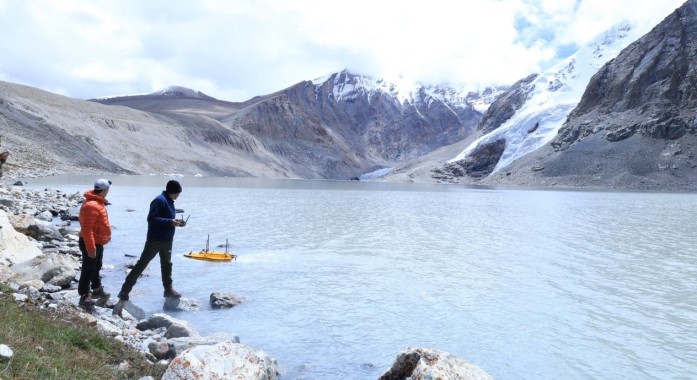
The
State Department of Science & Technology (DST), along with concerned State
departments and Central agencies, visited and studied 13 of these 16 highly
vulnerable glacial lakes, mostly in North Sikkim.All these sites are located
above 17,000 feet and are extremely difficult to access, requiring preparations
similar to those for a mountaineering expedition.
Three
glacial lake clusters in North Sikkim identified as posing the most potent
threatare Shako Chho, the North and South Lhonak lakes, and the Gurudongmar
Lake cluster.The State government has accordingly proposed mitigation measures
to the Government of India for these three glacial lake clusters.
