


Friday, Oct 30, 2026 09:15 [IST]
Last Update: Friday, Oct 30, 2026 03:42 [IST]


GANGTOK,:
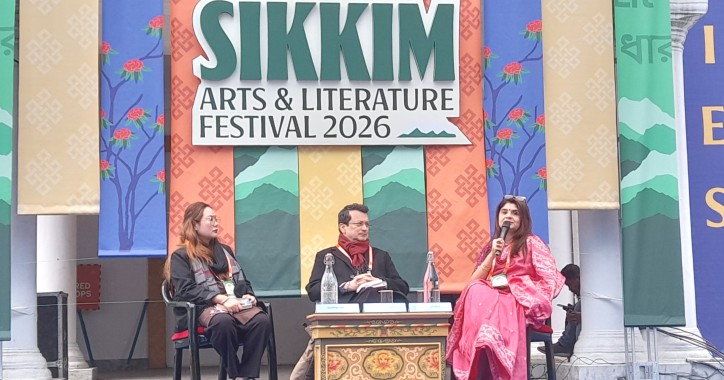
The second day of Sikkim Arts and Literature Festival at White Memorial Hall
and Orchidarium here brought together writers, poets, publishers, filmmakers,
theatre practitioners and conservationists for a series of engaging discussions
exploring the power of language, the art of storytelling, the publishing
industry and the urgent need to protect the region’s cultural and ecological
heritage.
The
day featured conversations on oral traditions and translation, children’s
literature, crime and horror writing, the evolving landscape of publishing,
folklore and biodiversity conservation. Each session also included interactive
elements and question-and-answer segments, encouraging audiences to engage
directly with the speakers. Alongside the literary sessions, a series of indoor
workshops offered participants opportunities to explore illustration, theatre,
prose writing and expressive arts.
The
day began with a session, titled “In Other Words: Across Languages”, featuring
poet and cultural theorist Ranjit Hoskote and author Sandhya Subba in
conversation with Arundhati Nath of Teamwork Arts. The discussion centred on
oral lore, the complexities of translation and the importance of preserving
indigenous knowledge for future generations.
Subba,
who has authored five published works, spoke about her journey from research to
writing, describing how she became a writer almost inadvertently through her
work as a researcher. She highlighted the urgency of documenting oral
histories, particularly the Yakthung Mundum tradition, and emphasised their
value as a cultural bridge for younger generations. These narratives, she
noted, carry cautionary lessons and ecological knowledge that remain relevant
to contemporary society.
Hoskote
reflected on the process of transferring oral narratives into written form and
the political dimensions of translation. “Translation for me is always a
political act,” he said, cautioning against rigid notions of identity and
cultural belonging. “Tragedy of modernity is that we're trying to confine
ourselves into a rigid, hard-edged identity,” he observed.
The
speakers also examined the technical challenges of translation, including the
responsibility to communicate an original message while preserving its cultural
nuances. Subba pointed out that certain concepts cannot be translated directly
into English, making contextualisation and footnotes essential tools for
retaining the depth and beauty of the original meaning. The conversation
further explored the evolution of Urdu, the diversity of South Asian cultures
and the ways in which ideas of linguistic purity can obscure the histories and
interactions that shape languages.
Emphasising
the importance of looking inward for knowledge and inspiration, Subba shared a
message for young people: “In our culture we have everything that we are
learning from outside.” The session underscored the empowering potential of
indigenous narratives and the need to preserve them through documentation,
translation and continued engagement.
Another
session, “Tiny Tales, Tall Stories”, turned the spotlight towards children's
literature and the power of imagination. Author Anuradha Sharma and Charmi
Chheda, theatre director, filmmaker and founder of Snow Leopard Theatre in
Bhutan, spoke with Puneeta Roy, founder of Yuva Ekta Foundation.
Chheda
reflected on her longstanding affinity for storytelling and imagination,
discussing Donkula, a book based on a true story about a bull that grows up
among dogs and gradually adopts their behaviour. Intended for both children and
adults, the book also carries a charitable purpose, with 100 per cent of its
profits going to the Royal Society for the Prevention of Cruelty to Animals
(RSPCA). A theatrical adaptation of the story is currently in development.
Sharma
discussed the process behind writing the biography of Ganju Lama, drawing on
her varied experiences as a journalist and mother. She stressed the importance
of making regional history accessible to children, advocating for more
non-fiction children's books that introduce young readers to the heroes and
significant figures of their own region. By presenting facts through an
engaging, story-driven approach, she said, authors can make history more
accessible and meaningful. The conversation also touched upon the role of
personal experience in storytelling and the place of artificial intelligence in
creative work, with Chheda expressing the view that AI has no place in art.
Following
the lunch break, the festival resumed with “A Stranger in the Mist”, a
discussion on the craft of crime and horror writing. Satyajit Sarna, a writer
and lawyer specialising in human rights and environmental law, joined Bengali
author and statistician Sakyajit Bhattacharya, who has written nine novels, in
conversation with writer, columnist and podcaster Sandip Roy.
The
session examined the enduring appeal of crime and horror fiction, exploring how
writers construct suspense, develop unexpected twists and delve into the
psychological complexities of their characters. The conversation highlighted
the genre's ability to probe the darker corners of the human mind while keeping
readers engaged through tension, atmosphere and uncertainty.
The
publishing industry took centre stage in “Alchemy of Publishing: What Makes a
Story?”, featuring publisher Anurag Basnet and writer Kanishka Gupta in
conversation with bookseller and publisher Raman Shresta. The speakers examined
what makes a story compelling, how publishers identify narratives that resonate
with readers and the strategies involved in turning manuscripts into books that
matter.
The
discussion also addressed the relevance of books in an increasingly digital
world, the impact of artificial intelligence on publishing and the continuing
challenges of curation and accessibility. Practical insights into the
publishing process offered aspiring writers and readers a closer look at the
decisions and intricacies involved in bringing a book to the public.
Writing
Folklore
and cultural memory took centre stage at “Once Upon a Hilltop: Folktales and
Folklore,” where writer Sandhya Subba and author Subi Taba engaged in a
conversation with Professor Rosy Chamling on the journeys of stories across
landscapes and generations.
The
discussion explored how folk narratives shape beliefs, nurture imagination and
preserve the collective memory of communities, highlighting their enduring
relevance in a rapidly changing world.
The
day's programme also turned towards the natural world with “The Wild Pulse”,
featuring conservation biologist and author Neha Sinha, American author Stephen
Alter and writer and environmental defender Yuvan Aves in conversation with
journalist Pema Wangchuk Dorjee. Through stories and striking imagery, the
speakers explored the importance of conserving biodiversity and protecting the
Himalayan environment. The discussion emphasised that safeguarding the
mountains and their ecosystems is not merely a conservation concern, but a
matter closely connected to survival, wonder and humanity's place in the
natural world.
Beyond
the main sessions, White Memorial Hall hosted several workshops that allowed
participants to engage with different creative practices. Ujjain Dutta led “The
Studio: Illustrations Workshop”, exploring the visual dimensions of
storytelling. Charmi Chheda’s session, “In the Moment: Exploring
Buddhist/Himalayan Theatre and Performance Techniques”, offered participants an
opportunity to engage with regional performance traditions. Author Chetan Raj
Shrestha’s session on “The Craft of Prose” focused on the practice of writing,
while Puneeta Roy conducted an expressive arts workshop centred on
self-exploration and identity, which was titled “Finding Me: A Search for
Identity, a Search for Self”.
Across
its diverse sessions, the second day of the Sikkim Arts and Literature Festival
highlighted the interconnectedness of literature, culture, identity and the
environment. From preserving indigenous oral traditions and bringing regional
heroes to younger readers to examining the future of publishing and advocating
for biodiversity, the discussions reinforced the role of storytelling as a
means of documenting heritage, questioning contemporary realities and imagining
a more culturally and ecologically conscious future.
