


Wednesday, Nov 04, 2026 23:30 [IST]
Last Update: Tuesday, Nov 03, 2026 17:50 [IST]


GANGTOK,: With the aim of
supporting the conservation, development and scientific improvement of
indigenous Siri cattle found in the region, Union Minister for Fisheries,
Animal Husbandry and Dairying Rajiv Ranjan Singh has proposed the establishment
of a Centre of Excellence dedicated to Siri cattle (local cows) in Sikkim,
provided the State government identifies and provides suitable land for the
establishment of the centre.
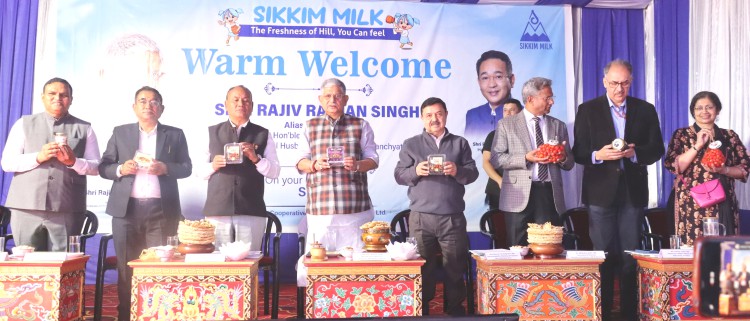
The proposal was announced at an event
organised at Sikkim Milk Union (SMU) at Lumsey here on Tuesday.
Organised by the Sikkim Cooperative
Milk Producers’ Union Limited, the event was attended by Ministers Puran Kumar
Gurung and GT Dhungel, National Dairy Development Board (NDDB) chairman Dr
Meenesh C. Shah, dignitaries from the Centre, Sikkim Milk Union (SMU) chairman
Yam Kumar Sharma, managing director TB Ghatani and other invited guests.
The Union Minister is on an official
three-day visit to Sikkim from November 1 to 3.
“On Monday, I visited Mangan district
and, while interacting with a local cow owner, I learnt that it was difficult
for her to sustain her livelihood when her cow produced only three litres of
milk. Right there, I decided that wherever the State government provides land
in Sikkim, we will approve and establish a Centre of Excellence,” the Union
Minister said.
He informed that through the Centre of
Excellence and IVF technology, cows could be impregnated and the resulting
calves provided to farmers.
“The biggest feature of IVF technology
is that if a calf is born through it, its milk production capacity increases
three times,” he added.
Singh urged the NDDB chairman to
extend full cooperation to the Sikkim government. Citing the example of
Mizoram, he instructed the NDDB to modernise Mangan's dairy processing plant by
investing in it using the same model implemented in Mizoram.
“The Central government is fully
prepared to cooperate with the Northeast. The goal of Prime Minister Narendra
Modi is to make the Northeast self-reliant and empowered. Hence, the Prime
Minister has instructed all Union Ministers to visit every Northeastern State,
understand their problems and extend cooperation for their benefit. Whatever
proposals come to us, we will view them positively and approve them. By
2029-30, our target is to increase milk production in Sikkim to 3.6 lakh
litres, and we are moving forward with that goal,” stated Singh.
He informed that milk collection
currently stands at 61,000 litres per day, with the first target being to
double the collection to 1.2 lakh litres per day.
The Union Minister inaugurated the
microbiology laboratory at Lumsey in Gangtok, virtually inaugurated the
microbiology laboratory at Karfectar in Jorethang and launched the churpi
traceability initiative. He also launched Fodder Plus FPO products and
distributed registration certificates to newly established dairy cooperative
societies.
The Union Minister informed that he
had met Chief Minister Prem Singn Tamang-Golay on Tuesday morning and
appreciated the State government's initiative of providing incentives of Rs 8
per litre to milk producers associated with cooperative societies.
He urged the State government to
increase the number of cooperative societies and bring the milk sector from the
unorganised to the organised sector through cooperatives. This, he said, would
increase milk collection and processing capacity while ensuring better-quality
products for consumers in the market.
“The most important thing is that the
more you strengthen cooperative societies and the more new cooperative
societies are formed, the more your milk collection will increase. And if your
milk collection increases, your processing capacity will also expand. When
processing expands, you will be able to fulfil market demand and become
self-sufficient. We distributed five certificates today. Next time, when you
establish 500 new cooperative societies, invite us and we will come and
distribute certificates to all 500 cooperative societies,” said the Union
Minister.
Highlighting the role of the NDDB and
the new cooperatives, he informed that the NDDB chairman had been collaborating
with the Sikkim government for the past 10 to 15 years.
He also briefed the gathering on the
national status of the dairy sector and the Prime Minister's initiatives,
stating that the issue of milk production was not just Sikkim's concern but a
challenge faced by the entire country.
“Today, in terms of milk production,
India stands at number one in the world and number two in fish production, due
to the Prime Minister's initiatives,” he said.
Highlighting one of the biggest
challenges in the milk sector, the Union Minister said that milk adulteration
occurred due to milk collection from the unorganised sector.
SMU managing director TB Ghatani gave
a presentation on the Sikkim Milk Union, highlighting the growth in milk
production, the development of cooperative societies, progress in cattle
rearing and milk collection, among other aspects.
“Over the past decade, milk production
in Sikkim has grown by 79%. Earlier, production stood at 1.37 lakh litres per
day, which has now increased to 2.45 lakh litres per day. The per capita
availability of milk per person per day has also made remarkable progress.
Although it is currently slightly lower than the national average, the progress
made in this regard is quite good,” said Ghatani.
He informed that there had been
significant progress in the formation of cooperative societies in Sikkim. While
there were only 389 cooperative societies in 2014-15, the number increased to
733 in 2025-26, representing a growth of about 88%.
The number of cattle rearers
associated with cooperative societies has also increased significantly, from
10,000 to 16,000. Milk collection has risen from 17,000 litres per day to
61,000 litres per day, marking a growth of 259%, informed the SMU managing
director.
Ghatani said this remarkable increase
reflected the extensive work undertaken by the State government in this
direction.
The volume of milk products delivered
by SMU to consumers has also increased from 28,000 litres to 56,000 litres,
registering a 100% growth over the past few years. Milk chilling and processing
plants play an important role in the collection and processing of milk. Sikkim
has established a milk chilling capacity of 79,000 litres per day.
The milk processing capacity currently
stands at 90,000 litres per day. The volume of processed products sold by SMU
in the market has also increased significantly alongside the expansion of
processing capacity. Curd and yoghurt production, in particular, has registered
a growth of 148%, reflecting a sharp rise in demand, said Ghatani.
