Wednesday, Jul 08, 2026 22:30 [IST]
Last Update: Tuesday, Jul 07, 2026 16:56 [IST]


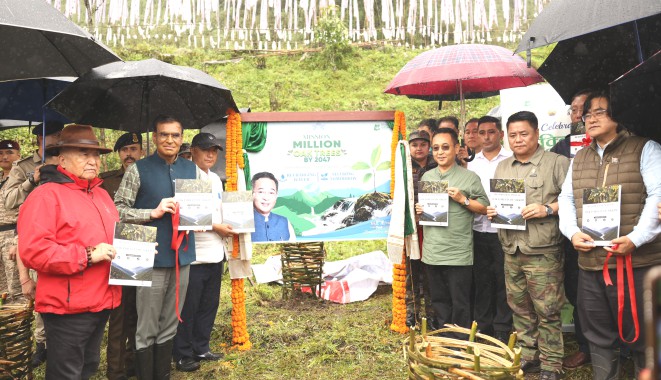
GANGTOK, (IPR): Sikkim on Tuesday launched the ambitious “Mission: Million Oak
Trees by 2047”, a State-wide ecological restoration programme aimed at reviving
Himalayan oak forests to strengthen water security, biodiversity and climate
resilience.
Chief
Minister Prem Singh Tamang-Golay launched the initiative during the observance
of “A Day for Mother Earth”, organised by the Forest and Environment Department
as part of Sikkim Paryavaran Parva 2026 at Lagyap Reserve Forest along J.N.
Road.
The
Chief Minister ceremonially planted the first oak sapling under the mission,
released the Oak Forest Restoration Manual, and launched the “Connect to
Forest” toll-free helpline (1926) to enable citizens to report grievances,
human-wildlife conflict, and hazardous trees and access Forest Department
services. He also distributed Entry Point Activity support to various groups,
handed over Shishu Samriddhi Yojana benefits to three beneficiaries, and
flagged off a safari vehicle for Barsey Rhododendron Wildlife Sanctuary along
with nine patrol vehicles for Forest Department divisions.
Extending
his greetings, the Chief Minister described the Mission Million Oak Trees
campaign as a landmark initiative to strengthen ecological security,
biodiversity conservation and long-term water sustainability through
large-scale plantation of native oak species.
Recalling
that “A Day for Mother Earth” was instituted in 2019, he said it was conceived
to encourage every citizen to dedicate a day annually to environmental
conservation. He added that Sikkim Paryavaran Parva was envisioned as an
environmental festival to promote public participation in conservation efforts.
Highlighting
the challenges posed by climate change, deforestation and declining water
resources, he stressed that environmental conservation is a shared
responsibility involving government departments, educational institutions,
local bodies, NGOs and citizens.
The
Chief Minister informed that all Sub-Divisional Officers have been directed to
utilise vacant government land for plantations and kitchen gardens with the
participation of government employees, citing Mangalbaria Sub-Division as a
successful example of community-led land revival.
He
noted that Sikkim has 47.33 per cent forest cover, with nearly half of its
geographical area under forest administration and 33.77 per cent designated as
protected areas and wildlife sanctuaries. He called for preserving and
expanding the State’s green cover while maintaining a balance between
conservation and strategic infrastructure development.
Highlighting
initiatives such as Mero Rukh Mero Santati, Mero Bato Mero Bote, Shishu
Samriddhi Yojana and the declaration of Khecheopalri Lake as a Ramsar Site, he
urged scientific monitoring of sapling survival, better maintenance of roadside
plantations and greater participation of MLAs, local bodies and NGOs.
Welcoming
the Connect to Forest helpline, he said it would improve public access to
forestry services, while emphasising that oak and chestnut plantations would
enhance groundwater recharge and long-term water security.
Reaffirming
the government’s commitment to environmental protection, the Chief Minister
said no new encroachments on forest or government land would be allowed and
urged citizens to actively safeguard Sikkim’s forests and biodiversity.
Addressing
the gathering, Forest and Environment Minister Pintso Namgyal Lepcha said the department’s
selective thinning of Juniper (Juniperus indica) plantations was based on
scientific studies showing their adverse impact on groundwater recharge and
native vegetation. He clarified that the exercise was being undertaken after
obtaining the required approvals from the Government of India.
The
Minister said the cleared areas would be restored with native oak species,
noting that Sikkim is home to nearly 12 varieties of oak which have shown
promising results in nursery trials. He announced that the department aims to
plant one million oak trees by 2047 to strengthen environmental conservation,
water security and contribute to the vision of Viksit Bharat 2047.
Referring
to the Government’s BIPASA Mission, he said the programme places equal emphasis
on water security alongside road and power infrastructure, adding that the
large-scale oak plantation drive would play a key role in rejuvenating the
State’s water resources. He appealed to the people to continue supporting
forest and biodiversity conservation.
The
programme also included the administration of the Paryavaran Parva pledge by
the Chief Minister. Earlier, ACS cum PCCF, Forest Department, Pradeep Kumar
delivered the welcome address, while Advisor, Forest Department, Tenzing Norbu
Lamtha proposed the vote of thanks.
Later,
the Chief Minister inaugurated the Sikkim Forest Training Institute at
Bulbuley, established under the JICA-assisted Sikkim Biodiversity Conservation
and Forest Management Project.
A
brief presentation on the Forest Training Institute was made by Director FTI
Tshering Pintso Bhutia.
The
institute will serve as the State’s premier centre for training, research and
capacity building in forestry, biodiversity conservation and sustainable
natural resource management, while strengthening the technical expertise of
frontline forest personnel. He was accorded a ceremonial guard of honour on
arrival.
Million
Oak Trees by 2047 is a flagship ecological restoration initiative of the
Government of Sikkim aimed at reviving the State’s native Himalayan oak forests
to enhance water security, biodiversity and climate resilience. Aligned with
the vision of Viksit Sikkim 2047 and launched under the theme of sustainable
environmental stewardship, the mission seeks to plant one million oak trees by
2047. By restoring degraded forest landscapes, improving groundwater recharge,
strengthening watersheds and increasing carbon sequestration, the initiative is
expected to play a crucial role in conserving fragile mountain ecosystems while
ensuring long-term ecological and water security for future generations.
The
programme had the presence of Deputy Speaker SLA Raj Kumari Thapa, Ministers,
Advisor-cum-MLAs, Advisor to CM, Political Secretary to CM, Advisors, Head of
Departments, OSDs, senior officials and staff of Forest department along with
local public.
BOX
MATTER
“Mission: Million Oak Trees by
2047”
Viksit Sikkim 2047 through BiPaSa
Reviving Himalayan Oaks: Nature’s
Pathway to Water Security and Climate Resilience
Oak
forests constitute one of the most significant broad-leaved forest ecosystems
of the Himalayan region. Belonging to the Fagaceae family—primarily the genera
Lithocarpus,
Quercus, and Castanopsis—oak species play a critical ecological role as keystone
species within mountain landscapes.
These
forests function as vital ecological powerhouses and natural water reservoirs.