


Tuesday, Sep 22, 2026 00:00 [IST]
Last Update: Monday, Sep 21, 2026 18:27 [IST]


NEW DELHI, (IANS): The government on Monday
appealed to employees of public sector banks and regional rural banks to call
off their proposed 3-day strike from September 28 to 30 as it has already
fulfilled one of their main demands by holding the Performance Linked Incentive
(PLI) scheme in abeyance.
"Given that most concerns of the Unions have been
substantially addressed, that the remaining demand continues to be examined,
and that the government continues to proactively introduce welfare measures for
the banking workforce, bank employees are urged to refrain from resorting to
strikes, work towards resolving issues through dialogue, and ensure that
banking services remain uninterrupted," a Finance Ministry statement said.
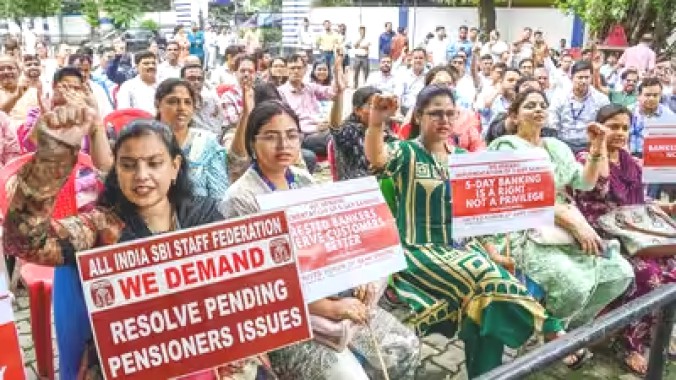
The United Forum of Bank Unions and certain other Unions
of Public Sector Banks as well as Regional Rural Banks have called for a series
of strikes in support of their demand for implementation of a five-day banking
week, and withdrawal of the Performance Linked Incentive (PLI) scheme. Taking
due note of the concerns raised, the government, after detailed discussion,
decided to keep the PLI scheme in abeyance. This proactive initiative by the
government fulfilled one of the two main demands of the Unions, the statement
said.
Banking as a service is relied upon by every citizen, and
its continuity directly affects the everyday lives of the general public. In
the interests of bank employees, the government declared the 2nd and 4th
Saturdays of every month as public holidays for public sector banks in 2015.
The remaining Saturdays continue to serve as an important opportunity for many
citizens to access banking services easily.
The proposed 3-day strike period, from September 28 to
30, also coincides with the half-yearly closing of banks on September 30, a
date of particular significance for reconciliation, provisioning, and treasury
and market operations. A disruption of this nature, combined with the preceding
weekend, would result in an effective five-day closure of banking services at a
particularly sensitive point in the financial calendar — causing considerable
inconvenience to customers, businesses, government transactions, and
international banking operations, the Finance Ministry further stated.
Public sector banks today stand on a healthy and robust
footing — a position achieved through the sustained efforts of the government
and active contribution of bankers and bank management over the years. It is
necessary to preserve and build on this success, in the collective interest of
banks, their employees, and the citizens they serve. Strikes, or disruption of
work in any form, will adversely affect the banks, the statement pointed out.
The government held several rounds of conciliation to
address the outstanding issues through dialogue, in keeping with the
established practice of resolving differences bilaterally. Despite the
government having resolved one of the two major demands of the union, and
sustained conciliatory engagement, a one-day strike was held on September 11,
with a further three-day strike now scheduled from September 28 to 30, and an
indefinite strike proposed from October 26 on the single demand of a five-day
workweek for banks.
Strikes cause disruption in banking services that
inconvenience the public, impact the business of the bank, and ultimately harm
the interests of bank employees. There is no fruitful outcome that is achieved
through strikes. The government remains committed to the welfare and well-being
of bank employees and to addressing their genuine concerns through constructive
engagement, the statement added.
