


Friday, Sep 04, 2026 10:30 [IST]
Last Update: Thursday, Sep 03, 2026 17:21 [IST]


GANGTOK, :The Department
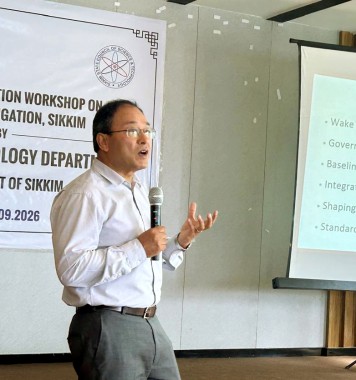
of State Science and Technology (DST) organised a media sensitisation workshop
on Glacial Lake Outburst Flood (GLOF) risk mitigation in Gangtok on Thursday.
The workshop was aimed at sensitising media
representatives on issues related to GLOF risk mitigation and strengthening
awareness and understanding of glacial flood risks in the State.
SDTprincipal director D.G. Shrestha delivered a detailed
presentation on the department’s studies on glacial lakes and the measures
being undertaken to mitigate GLOF risks in the State.
During his presentation, Shrestha highlighted the
vulnerability of Sikkim’s high altitude glacial lakes and the need for
continuous scientific assessment, monitoring and early-warning mechanisms to
minimise risks to downstream communities.
He spoke about the scientific studies undertaken
by the department to understand the condition and behaviour of potentially
hazardous glacial lakes. The studies involve assessment of lake
characteristics, surrounding terrain, hydrology and other factors that could
contribute to a possible GLOF event.
The DST has been conducting multidisciplinary
expeditions to high-risk glacial lakes, collecting bathymetric, geological,
geophysical, hydrological, geomorphological and meteorological data to
strengthen GLOF hazard and risk assessment, said Shrestha.
Shrestha also highlighted the importance of GLOF
modelling, hazard assessment, early warning systems and mitigation planning.
The studies are intended to provide scientific inputs for identifying
vulnerable areas and developing appropriate measures to protect lives,
infrastructure and livelihoods downstream.
The State has prioritised high risk glacial lakes
for detailed assessment and preparation of mitigation plans. Following the 2023
South Lhonak GLOF, the government has intensified scientific investigations and
mitigation efforts, with 16 Category-A high risk glacial lakes identified under
the National Disaster Management Authority framework being prioritised for
detailed assessment.
The presentation also underlined the importance of
coordination among government departments, scientific institutions, disaster
management agencies and local communities in addressing GLOF risks.
During the workshop, DST chief engineer Asim
Basnet made a detailed presentation on the department’s mitigation proposal for
GLOF prone areas in the State.
Basnet outlined the proposed measures aimed at
reducing the potential impact of GLOF events and protecting downstream
communities, infrastructure and other critical assets. He explained that the
mitigation strategy has been formulated based on scientific assessments of
vulnerable glacial lakes and their surrounding areas.
The presentation focused on the need for site
specific mitigation measures, taking into consideration the characteristics of
individual glacial lakes, downstream settlements and infrastructure, as well as
possible flood pathways. Recent assessments in Sikkim have also identified
specific high-risk areas where detailed mitigation measures are being
considered.
Basnet emphasised the importance of combining
structural and non-structural measures with continuous monitoring and early
warning mechanisms. Such interventions, he said, would help strengthen
preparedness and reduce risks in the event of a sudden glacial lake outburst.
The mitigation proposal is part of the State’s
wider efforts to strengthen GLOF preparedness following the 2023 South Lhonak
GLOF, which highlighted the vulnerability of downstream areas to glacial lake
related hazards.
SSDMA special secretary-cum-director Prabhakar Rai
elaborated on the role of the authority during natural disasters and stressed
the importance of preparedness, coordination and timely response to minimise
loss of life and property.
Rai explained that SSDMA works in coordination
with various line departments, district administrations and other agencies
during disasters. He emphasised that effective disaster management requires
clear communication, coordinated response and prompt action from all
stakeholders.
He highlighted the importance of preparedness
before a disaster occurs, including identifying vulnerable areas, developing
evacuation plans, strengthening early-warning mechanisms and ensuring that
communities are adequately informed about possible hazards.
Rai also stressed the need for community
participation and public awareness, particularly in a state like Sikkim that
remains vulnerable to landslides, flash floods, earthquakes and other natural
hazards. He said that awareness among local communities can play a crucial role
in ensuring timely evacuation and reducing casualties during emergencies.
He further underlined the importance of
maintaining seamless communication between authorities during a disaster so
that warnings and directions reach people on the ground without delay. The
SSDMA has also emphasised coordination among nodal officers to ensure
systematic workflow during natural calamities.
DST principal secretary Dr. Sandeep Tambe briefed
media representatives on the various initiatives and ongoing works of the
department. He outlined the department’s work in science and technology,
climate and glacier studies, disaster risk reduction, remote sensing, biotechnology,
technology transfer, research and capacity building. The DST’s mandate includes
promoting scientific research and facilitating the application of appropriate
technologies for the State’s development, he said.
