


Thursday, Apr 02, 2026 11:00 [IST]
Last Update: Wednesday, Apr 01, 2026 17:58 [IST]


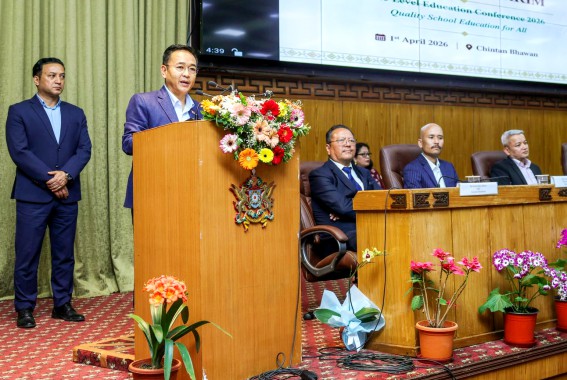
GANGTOK, (IPR): The School Education department on Wednesday organised a
programme titled “Developing Human Capital for Viksit Sikkim – Quality School
Education for All”, at Chintan Bhawan, bringing together policymakers, senior
officials and education experts to deliberate on strengthening the State’s
school education system.
The
programme was graced by Chief Minister Prem Singh Tamang-Golayas the chief
guest, along with Minister, Education Department, Law Department and Sports
& Youth Affairs Department, Raju Basnet as the guest of honour.
Addressing
the conference, the Chief Minister said that the gathering marked a significant
milestone in the State’s efforts to strengthen and transform the education
sector.
Expressing
satisfaction over the successful conduct of the conference, the Chief Minister
said that the programme was not merely an administrative review, but a serious
and collective exercise aimed at shaping the future of Sikkim through
education. He remarked that the presence of officers, educators and
grassroots-level policy implementers from all corners of the State reflected
the commitment and sincerity of the department and its personnel.
The
Chief Minister stated that education is the foundation of progress and the
backbone of a strong and prosperous society. He underscored the importance of
further strengthening Sikkim’s education policy, stating that it must evolve
into one of the finest systems in the world that’s accessible, inclusive and
uncompromising in quality.
Calling
for focused reforms, the Chief Minister said that government schools must become
the first and most preferred choice for parents and students. He observed that
the qualifications, experience and training of teachers in government schools
are often stronger than those in private institutions, and that government
schools also function within a sound administrative framework. Yet, he noted,
many parents continue to prefer private schools. He urged the department to
carefully examine the reasons behind this preference and to work with renewed
determination to create a reverse exodus, where parents and students would
increasingly choose government schools over private institutions.
The
Chief Minister further emphasised that the goal should not be merely to educate
students, but to create individuals capable of succeeding in any corner of the
world.
Referring
to the deliberations and presentations made during the conference, the Chief
Minister appreciated the quality of the presentations and noted that they had
clearly identified the shortcomings in the existing system while also offering
practical suggestions and pathways for improvement. He directed that the
presentations be made available to all officers of the department for future
reference and institutional learning.
Describing
the conference as the first of its kind in the State, the Chief Minister said
he had envisioned it as a more interactive, two-way platform, and expressed
hope that future conferences would encourage broader participation,
idea-sharing and field-based experiences from officers and educators. He stated
that such conferences should be organised periodically to review progress,
assess outcomes and identify remaining challenges.
The
Chief Minister said that education is an asset that can never be stolen, and
reiterated that the government considers education one of its highest priority
sectors. He said the State government is making sustained efforts to bring
global-level education to Sikkim through strategic tie-ups, partnerships and
policy support.
He
acknowledged that while flaws and disparities still exist within the system,
these can be addressed only through collective effort, commitment and honesty
of purpose. He called upon all stakeholders to work together as Team Education
and Team Sikkim to eliminate disparities and revamp the education system in a
meaningful and lasting manner.
The
Chief Minister also appreciated the department for bringing forward the Teacher
Transfer and Posting Policy, and suggested that it be considered for conversion
into an Act, so as to make it more binding, transparent and equitable for all
concerned. He further recalled that the government had introduced a Teacher
Regularisation Policy in 2021, which has enabled the regularisation of several
teachers in a smooth and systematic manner.
Reaffirming
the Government’s full support to the sector, the Chief Minister highlighted
several student and teacher centric initiatives introduced by the State
Government. He mentioned that National Awardee teachers are sent for
international exposure tours, while State Awardees are sent for national exposure
visits. He also referred to schemes such as the Nar Bahadur Bhandari Fellowship
Scheme, the APATAN Scheme, and the Chief Minister’s Education Assistance
Scheme, under which eligible students receive financial assistance of up to Rs.
20 lakh for pursuing MBBS.
In
conclusion, the Chief Minister called for collective action, courage and
innovation in reimagining education in Sikkim. He said that with commitment,
vision and coordinated effort, the State can build an education system in which
government schools inspire trust, opportunity becomes universal, and Sikkim
emerges as a benchmark of educational excellence.
Addressing
the gathering, Minister Raju Basnet underscored the importance of sustained
efforts in improving educational standards and ensuring equitable access to
quality education across the State. He said the programme had provided an
important platform to deliberate on the future course of the State’s school
education system. He noted that certain indicators had revealed alarming
trends, helping the department identify critical gaps and initiate corrective
measures.
He
stressed the need to improve enrolment and create a more enabling learning
environment, while emphasising that the ultimate focus of every policy must
remain on student welfare. He also underlined the importance of adopting
personalised learning pathways and evolving pedagogy in line with changing
times and the individual capacities of students.
The
minister further pointed out the need for a comprehensive training database to
track teacher capacity-building programmes conducted by SCERT, so as to
identify who has been trained and who still requires training.
Referring
to the Teacher Transfer and Posting Policy, he said the policy was timely and
should eventually be strengthened through legislation to ensure equity and
fairness for all.
He
said the conference was a significant and unprecedented initiative, and called
upon all stakeholders to draw inspiration from it and work collectively towards
building a Viksit Sikkim through a Sunaulo, Samriddha and Samartha Sikkim.
Earlier
in his welcome address, Tashi Chophel Lepcha, secretary, School Education, set
the context by highlighting the State’s commitment to improving learning
outcomes and building a robust education ecosystem aligned with the vision of a
Viksit Sikkim. He also made a presentation on Quarterly School Visit and
Monitoring Framework.
AD
Chhetri, director, Samagra Shiksha, presented an overview of the challenges
facing school education, outlining key gaps and the need for targeted
interventions with a Vision 2030 for Government Schools.
A
series of thematic presentations followed, focusing on critical areas of
reform. Rajiv Philip, DD, SCERT, spoke on strengthening foundational
mathematics with EK Shaji, co-founder of JodoGyan interacting via online.
Tshering
L Bhutia, additional director, SCERT, highlighted initiatives for foundational
English. These sessions were complemented by virtual interactions with experts
from leading institutions, including Azim Premji University and the British
Council, providing broader academic perspectives.
Dr
Santi Ram Adhikari, director, SCERT, presented on PM e-Vidya and special
programmes for Science and Mathematics, while Asha Khatri, additional director,
Samagra Shiksha, elaborated on inclusive education, followed by an interaction
with Project Setu represented virtually by A Vijay Saradhi of the Empathy
Bridge Foundation.
The
session on CM Model School, presented by Ujjwal Khatiwada, director, CMMS,
featured the success story of CM Model School in Assam Linzey, highlighting how
in such a short time students have been able to gain state wide recognition
through a holistic education approach. He further presented on the progress
achieved in setting up two more CMMS in Hee Gyathang and Namthang which are
expected to be operational in 2027 and 2028.
Additionally
industry experts from national organisations such as J-PAL South Asia, EkStep
Foundation, and LEP, spoke on evidence-based approaches and digital learning
innovations in the education sector.
Further
deliberations included presentations on health, safety, wellness and values by
Anugrah E. Rai, additional director, and teacher transfer and posting policy by
Lakhi D Bhutia, special secretary.
Dr
Sandeep Tambe, principal secretary, in his presentation on “Quality Education:
Policy Suggestions,” outlined a roadmap to make government schools in Sikkim
the best in the country. He identified key challenges including declining
enrolment, low learning outcomes, weak English competency, inclusive education
gaps, teacher transfer issues and weak monitoring systems. He stressed the need
for weekly monitoring of learning outcomes, reintegration of dropout students,
support for children with special needs, English-friendly campuses, stronger
libraries, a Learning Enhancement Programme and a robust school monitoring
framework. He also presented eight policy suggestions aimed at improving
enrolment, academic progress, English fluency, school monitoring and teacher
management.
The
programme concluded with the presentation of a statue of Manjushri to the Chief
Minister and a vote of thanks proposed by C. Kiran Dahal, deputy director
(Planning), Education department.
The programme was attended by chairperson Student Welfare Board Sonam Chopel Sherpa, OSD Education department Sonam Palzor Bhutia, PCE cum secretary(Engineering Cell) Education department Chetraj Mishra, Chief Education Officers, principals from DIET Colleges and senior officers and staff of Education department.
