Saturday, Jul 25, 2026 10:00 [IST]
Last Update: Saturday, Jul 25, 2026 04:28 [IST]


GANGTOK,: Marking
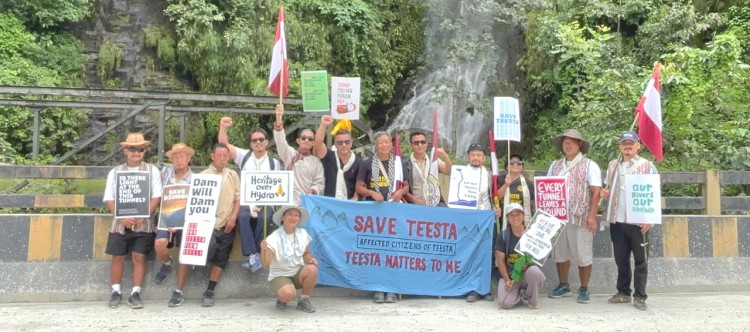
19 years of its movement to protect the Teesta River, the Affected Citizens of
Teesta (ACT) on Friday began a four-day foot march along
the
river, from Phidang in Dzongu, North Sikkim, to Melli in South Sikkim,
demanding
greater protection for the Teesta and raising concerns over hydropower projects
across the State.
The
march, organised under the theme “Teesta Matters to Me,” began after a
traditional Lepcha ritual in Dzongu, where monks offered prayers before
participants set out on the journey. The march will pass through Dikchu, Tumin,
Rangpo and the Teesta-Rangeet confluence at Triveni before concluding at Melli,
where ACT will submit a memorandum to the Governor and the Chief Minister.
Speaking
at the launch, ACT general secretary Gyatso Lepcha said the march comes at a
significant time, following the recent tunnel tragedy at the Teesta Stage VI
Hydropower Project in Samardung and nearly three years after the October 2023
Glacial Lake Outburst Flood (GLOF).
“What
better time than now, when we are witnessing disasters during the monsoon and
after the recent incident at Teesta Stage VI where more than 20 lives were
lost. As we walk along the river, we can see the stress and destruction this
cascade of dams has created in these fragile mountains,” he said.
Lepcha
said the movement was not limited to the people of Dzongu but represented
everyone connected to the Teesta.
“This
is not only a movement for the people of Dzongu. It is a movement for all the
people of Sikkim because the Teesta belongs to everyone. The river connects
communities from Sikkim to North Bengal and Bangladesh, and every community has
a right to a living river.”
He
said ACT has spent the last 19 years questioning large-scale hydropower
development on the Teesta and claimed the movement had helped stop several
proposed projects.
Referring
to the recent Samardung tunnel incident, Lepcha questioned the claim that
hydropower is a clean source of energy.
“The
Stage VI incident has exposed the narrative of dams being green and clean
energy. Tunnel construction releases methane gas, one of the most potent
greenhouse gases contributing to climate change. These projects were never
truly green.”
He
said visible erosion, sinking villages and damaged roads along the Teesta
showed that the environmental impacts of hydropower projects continued even
after the 2023 GLOF.
“The
priority appears to be rebuilding dams rather than rebuilding public
infrastructure and restoring the lives of affected people. Let the Teesta flow
in its natural course. Rivers should not be treated merely as sources of
electricity.”
The
ACT general secretary said the four-day march would cover more than 80
kilometres while connecting river communities from upstream to downstream.
After
completing the first day’s walk, Lepcha said participants received an
encouraging response from local communities.
“People
downstream welcomed us warmly. It was also important to see the condition
around Teesta Stage V. While restoration has been claimed, the erosion and
sinking villages along the stretch tell a different story.”
The
march will also pause near the Teesta-Rangeet confluence, where participants
will pay tribute to those who lost their lives during the 2023 GLOF and recent
project-related incidents.
ACT
member Mayalmit Lepcha described the march as an important effort to spread
awareness about the river’s ecological and cultural significance.
“The
Teesta is a transboundary river flowing from Sikkim through West Bengal and
into Bangladesh. For the Lepcha community, it has deep spiritual, cultural and
traditional importance. Protecting it is our responsibility.”
She
said participants witnessed several landslide-prone areas, damaged roads and
erosion while walking along the river.
“People
should understand that these are not only natural disasters. Human
interventions have intensified the damage. Before projects like the 510 MW
Teesta Stage V dam in Dikchu, people did not experience erosion on this scale.”
Questioning
the benefits of hydropower projects, she said local communities had sacrificed
land and livelihoods without receiving adequate returns.
“What
are we getting from these projects? We are sacrificing our land and our lives.
It is time for people to come out and speak for their future generations.”
Mayalmit
also said climate change and expanding glacial risks made continued dam
construction increasingly dangerous.
ACT
member Hishey Lachungpa, who previously campaigned against proposed dams in
Lachung, said public opinion had changed significantly over the years.
“Today,
very few people would say dams have brought development. People have seen the
damage. If our concerns are ignored, we will continue democratic protests,
whether through foot marches or demonstrations.”
He
said people’s participation had earlier helped prevent proposed hydropower
projects in Lachung and hoped similar public support would grow across Sikkim.
Young
participant Winona Lepcha said this was the first peace walk for many members
of her generation.
“For
youngsters like us, this is our first peace walk because we are deeply
connected with the Teesta. This walk is for the river, the mountains and the
future of Sikkim.”
She
said communities in Dzongu continued to face hardships following the 2023 GLOF.
“Dzongu
remained cut off for a long time after the GLOF. Local people risked their
lives to build cane bridges for transport and supplies. Many people living
along the river suffered, but there is still no clear data on how many lost
their lives or whether affected families were properly compensated.”
She
added that despite the challenges, the participants remained motivated
throughout the journey.
“Walking
beside the Teesta gives us strength. It feels like the river itself is
encouraging us to continue.”
Throughout
the march, ACT members highlighted concerns over major hydropower projects,
including Teesta Stage III in Chungthang, Teesta Stage IV in Dzongu, the 510 MW
Teesta Stage V project in Dikchu, Teesta Stage VI, the Panam project and other
projects undertaken by NHPC, arguing that repeated disasters and changing
climatic conditions warrant a review of dam development across the Teesta
basin.
The
four-day march will conclude at Melli in South Sikkim, where ACT will submit a
memorandum to the Governor and the Chief Minister seeking stronger protection
for the Teesta River and greater attention to the concerns of communities
living along its banks.