


Saturday, Mar 28, 2026 22:00 [IST]
Last Update: Friday, Mar 27, 2026 16:24 [IST]


KATHMANDU, (IANS): Balendra Shah, the
parliamentary party leader of the Rastriya Swatantra Party (RSP), has been
sworn in as the new Prime Minister of Nepal. The 35-year-old leader is the
youngest elected Prime Minister of Nepal.
President Ram Chandra Poudel on Friday appointed former
Kathmandu Metropolitan City mayor Shah—popularly known as Balen—to the post as
per Article 76(1) of the Constitution, the President’s Office said in a
statement.
On Thursday, the RSP, which secured a sweeping victory in
the recent parliamentary elections with a near two-thirds majority, elected
Shah as its parliamentary party leader, paving the way for him to become the
country’s 47th Prime Minister.
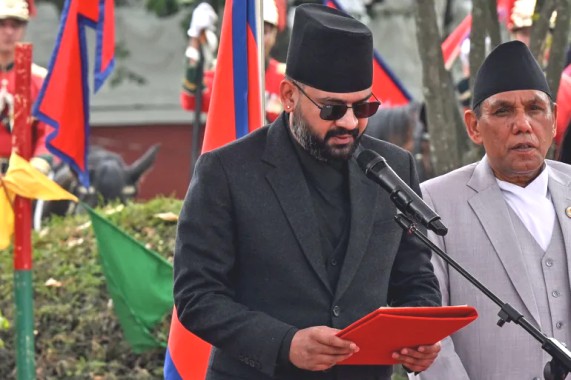
Prime Minister Shah took the oath of office at 12:34 pm
at the President’s Office on Friday, accompanied by Hindu rituals.
The 35-year-old former mayor is one of the youngest prime
ministers Nepal has ever had. A majority of lawmakers elected in the recent
elections represent younger age groups, marking a generational shift in Nepal’s
politics.
A popular figure among the younger generation, Shah’s
entry into national politics on December 28 last year is believed to have
contributed to a swing in votes for the RSP. The nearly four-year-old party ran
its election campaign by declaring Shah as its prime ministerial candidate and
secured a thumping victory in the March 5 parliamentary elections, winning 182
out of 275 seats in the House of Representatives.
Shah defeated former Prime Minister K P Sharma Oli by a
wide margin of 49,614 votes, securing 68,348 votes against Oli’s 18,734 in
Jhapa-5 in eastern Nepal. This marks the highest number of votes secured by any
candidate in Nepal’s parliamentary elections since 1991.
Shah entered politics in 2022, when he ran for mayor of
Kathmandu and won as an independent candidate.
Born on April 27, 1990, in Kathmandu into a Madhesi
family that valued education and culture, Shah completed his bachelor’s degree
in Kathmandu before pursuing a master’s degree in Structural Engineering from
Visvesvaraya Technological University in India.
His academic background in engineering gave him a
practical understanding of infrastructure, urban development, and public works,
which helped shape his governance approach during his tenure as mayor of
Kathmandu Metropolitan City.
