


Saturday, Mar 28, 2026 21:45 [IST]
Last Update: Friday, Mar 27, 2026 16:16 [IST]


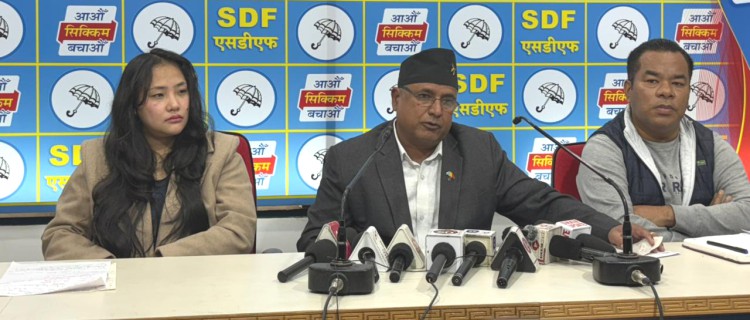
GANGTOK,: The Sikkim Democratic Front (SDF) on Friday announced that it will
not contest the upcoming Urban Local Body (ULB) elections, alleging that the
reservation of seats across communities is “unfair, unconstitutional and based
on an unverified census.”
Addressing
a press conference, SDF vice president Krishna Kharel said the party has
decided to boycott the elections until what it described as “just and
proportionate representation” is ensured. He questioned the State government’s
claim that a census was conducted in 2022, as stated by Chief Minister Prem
Singh Tamang-Golay during the one-day Assembly session on Thursday.
Kharel
said, “The Chief Minister stated in the Assembly that a census was conducted in
2022, but where is the record, when was it notified or made public. As far as
we know, the only legitimate census is the 2011 national census, and any
reservation should be based on that.” He further alleged that relying on an
unannounced survey amounts to a violation of Article 14 of the Indian
Constitution, which guarantees equality before law and equal protection of
laws.
Citing
community-wise distribution, Kharel claimed that the Gurung community has been
allocated only one seat across the State, the Limboo community two reserved
seats along with one unreserved, while the Tamang community has been given
eight reserved seats. He argued that based on earlier census data, Central OBCs
should have received around 17 seats instead of eight, and State OBCs around 14
to 15 seats instead of 11. “This reservation has been done arbitrarily without
proportionate representation. It is against the Constitution and against the
law,” he said.
The
SDF leader described the alleged 2022 exercise as a “party-based and
unannounced census,” adding that no all-party consultation or public
participation was undertaken before determining reservations.
“A
population survey cannot be carried out unilaterally. There should have been
discussions with all political parties and consensus before arriving at such
decisions,” he said. He added that the party had submitted its grievances to
the State Election Commission but received no concrete response.
“We
placed all our concerns before the Commission, but were told to come later.
Till now, there has been no proper hearing,” he said.
Raising
concerns over the timing of the elections, Kharel said the polls were declared
within six days of announcing the reservation matrix, leaving little scope for
political parties to respond. He also questioned the urgency of conducting ULB
elections in newly created districts such as Pakyong and Soreng, stating that
these areas are yet to be fully developed institutionally.
“There
were no public hearings before declaring these areas as Nagar Panchayats. When
existing panchayat and zilla structures are already in place, the need for such
hurried elections is questionable,” he said, also pointing out that the current
ULB bodies have not been formally dissolved, creating uncertainty over ongoing
public works.
Reiterating
the party’s stand, Kharel said, “Until all communities receive fair
representation, we will not participate in the elections. Accepting this
reservation would mean endorsing injustice.” He rejected suggestions that the
boycott reflects reluctance to contest, stating that the party is instead
fighting for constitutional rights and equitable representation. “This is not
about power or seats, it is about justice for all communities,” he said.
During
the Assembly session, Chief Minister Prem Singh Tamang-Golay had maintained
that the reservation exercise was based on a State-conducted census in 2022
approved by the Cabinet. He stated that unreserved seats have increased from 12
in 2021 to 13 in 2026, State OBC seats from nine to 11, Central OBC from six to
eight, while Scheduled Tribe seats have risen from 18 to 25 and Scheduled Caste
seats remain unchanged at six. He said the increase, particularly for Scheduled
Tribes, reflects their population share in urban areas and dismissed
allegations of imbalance as baseless, asserting that reservations have been
determined strictly on population data.
