


Saturday, Sep 05, 2026 22:45 [IST]
Last Update: Friday, Sep 04, 2026 17:15 [IST]


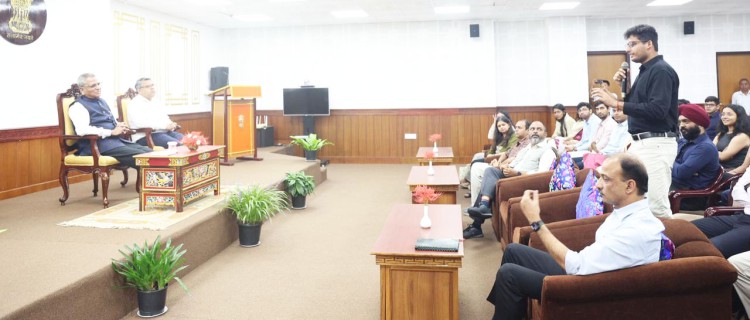
GANGTOK,: Governor Om Prakash Mathur on Friday interacted
with a group of students and teachers from Indian School of Business (ISB) of
Hyderabad and Mohali campuses at Lok Bhavan here.
They are in Sikkim as a part of their educational tour to study the
State’s organic farming, which was led by Professor Ashwini Chhatre, Executive
Director of Bharti Institute of Public Policy (BIPP), ISB Hyderabad and Professor
Abhijit Parmar, informs a Lok Bhavan press release.
Commissioner cum Secretary, Lok Bhavan, Jitendra Singh Raje welcomed the
visiting delegates.
During the engagement, the officials informed that students and faculty
members visited various parts of the State and interacted with progressive
farmers, members of Farmer Producer Organisations (FPOs), agricultural
scientists and experts from Krishi Vigyan Kendras, and women entrepreneurs.
During the discussion, students shared their experiences and finding of
their five-day field visits. They praised the coordination and cooperation
between the government and farmers which has played an important role in making
organic farming successful at the grassroots level.
They put forth several suggestions to the Governor on modernising and
strengthening the agricultural sector mainly Artificial Intelligence (AI)
driven technology which has emerged as a transformative force in modern
agriculture, revolutionizing traditional farming practices into smart
agriculture ecosystems, real time data insights, utilizing of drone for aerial
imaging to map fields, spot pests, and precisely distribute organic pesticides,
promotion of organic farming and other modes to protect crops from wild animals
They commended Sikkim's natural beauty, rich culture, women empowerment
and hospitality, said the Lok Bhavan.
The Governor lauded the observations and suggestions made by the
students and described Sikkim's organic farming is not only a model for India's
sustainable agriculture but also a model for the world. He called upon the
students to act as a bridge between modern scientific methods and traditional
tools of agricultural practices, so that it will boost farmers' incomes through
both agricultural production and post-production.
The Governor also asked the students to write down their field visit
observation and experiences and send them to Governor's Office.
“Sikkim is a setting example for protecting and sustainable development.
I have learnt so many things from the people of Sikkim,” he said.
Referring the vision of Viksit Bharat @2047, the Governor encouraged
students to harness technology, promote innovation, and develop adaptive
leadership capabilities to contribute meaningfully to India’s journey towards
becoming a developed nation.
The session witnessed a vibrant exchange of ideas which mainly focused
on the transformative role of innovation and technology in shaping modern
sustainable agricultural practices and the evolving challenges and
opportunities, adaptability and the ability to foster collaboration and trust
between the State and farmers.
The ISB officials expressed their gratitude to Governor for granting an
audience to the students, said the Lok Bhavan.
The Sikkim tour named ‘ISB Seed Study Trek 2026’ was to understand
Sikkim’s organic success and held from August 30 to September 5. The study trek
brought together 42 participants from different States across India, along with
four professors and staff members. The programmewas designed to provide
participants with an immersive, field-based understanding of Sikkim’s organic
farming journey, sustainable agricultural practices, rural livelihoods and
community-led development.
The Sikkim Tour Programmewas organized by Gangtok-based Adarsh Tours,
Treks & Expedition, under the coordination of Gopal Basnett, who facilitated
the field visits, local interactions and logistical arrangements for the study
trek.
As part of the programme, the ISB delegation visited several villages,
agricultural institutions and local markets across Sikkim. The villages visited
included Chalamthang, Namthang Krishi Vigyan Kendra, Perbing, Kewing, Bakhim,
and Gauley Bazar in lower Burtuk.
A key component of the study trek was the interaction with local traders
and members of the rural business community at Gaulay Bazar, Khelgaon and
Burtuk. These interactions provided participants with practical insights into
the marketing, distribution and commercial aspects of organic agricultural products.
The field-based engagements allowed participants to learn directly from
farmers, local communities, agricultural institutions and traders about the
opportunities and challenges associated with organic agriculture and
sustainable rural development, it was informed.
The ISB SEED Study Trek 2026 represent an important initiative in
experiential learning, offering participants an opportunity to study Sikkim’s
organic agriculture model, understand grassroots realities and explore the role
of communities, institutions and markets in building a sustainable rural
economy, said the organisers.
