Saturday, Jul 11, 2026 23:45 [IST]
Last Update: Friday, Jul 10, 2026 18:15 [IST]


GANGTOK, (IPR):
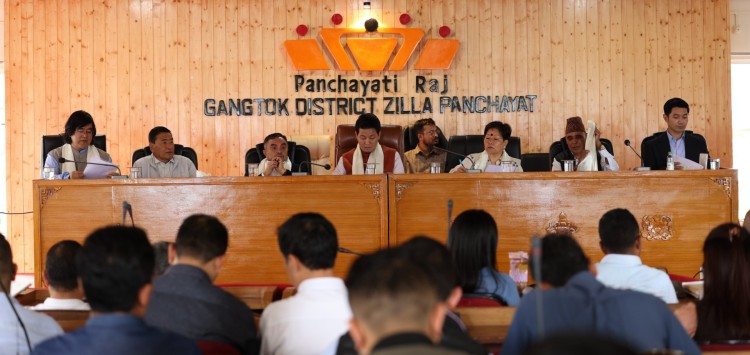
The District Development Coordination and Monitoring Committee (DISHA) meeting
for Gangtok district was held at the conference hall of Zilla Bhawan, Gangtok
today.
The
meeting was chaired by Member of Parliament (Lok Sabha) and DISHA chairman
Indra Hang Subba, in the presence of Roads and Bridges minister Nar Bahadur
Dahal (Chettri), MLAs Kala Rai, Samdup Tshering Bhutia and Tenzing Norbu Lamtha
and Gangtok Zilla Adhyaksha Balaram Adhikari.
The
meeting reviewed the implementation and progress of various Central and State
government schemes and development programmes being implemented across the
district.
In
his keynote address, MP and chairperson Indra Hang Subba appreciated the active
participation of all members in the meeting. He urged all departments to take
into account the suggestions and observations of the DISHA Committee while
implementing Centrally Sponsored Schemes.
He
directed the concerned departments to submit written replies, along with
definite timelines, on issues that could not be adequately addressed during the
meeting. He also instructed departments to specify the reasons for delays in
ongoing projects and outline the corrective measures being taken to ensure
their timely completion. He clarified that the committee's objective was not to
find fault with departments but to strengthen accountability, improve
coordination and enhance public service delivery. He added that regular
monitoring helps identify implementation gaps and enables departments to take
timely corrective action.
Highlighting
the importance of the DISHA Committee, Indra Hang Subba stated that the forum
plays a vital role in monitoring the effective implementation of government
schemes to ensure that their benefits reach the intended beneficiaries. He
emphasised that welfare schemes are designed to reduce socio-economic
disparities and improve the lives of the poor, vulnerable and marginalised
sections of society.
The
chairperson said that public representatives and government officials share the
responsibility of ensuring transparency, accountability and the efficient
implementation of development programmes. He urged departments to proactively
assist eligible beneficiaries facing difficulties due to a lack of awareness or
incomplete documentation so that no deserving person is deprived of government
support.
Appreciating
the efforts of the Commerce and Industries department, he called for greater
emphasis on skill development and entrepreneurship. He said the success of
training programmes should be measured through tangible outcomes such as
employment generation, enterprise creation and improved livelihoods.
He
further called for a more coordinated and people-centric approach to
development. Reiterating that public representatives and government officials
are accountable to the people, he urged every department to remain responsive
to public concerns and ensure effective delivery of government services.
Concluding
his address, Indra Hang Subba underscored the importance of preserving Sikkim's
unique identity and called upon everyone to work collectively with dedication
and commitment towards the inclusive and sustainable development of the State.
Speaking
during the meeting, Upper Burtuk MLA Kala Rai emphasised the need for
departments to work in close coordination to ensure the timely and effective
implementation of government schemes. She urged officials to adopt a
collaborative approach in addressing implementation challenges and strengthening
service delivery so that the benefits of various welfare and development
programmes reach every eligible beneficiary across the district.
Earlier,
the programme commenced with a welcome address delivered by Gangtok ADC
(Development) Rajani Sharma.
This
was followed by a presentation on the highlights of the minutes of the previous
DISHA meeting and the significance of the committee by Gangtok ADC Sisum
Wangchuk Bhutia.
During
the meeting, the Rural Development department, Agriculture department, Social
Welfare department, Health and Family Welfare department and the Commerce and
Industries department delivered PowerPoint presentations on the implementation
and progress of various flagship Central and State government schemes under
their respective departments.
The
Rural Development department presented the progress of the Jal Jeevan Mission
(JJM), which aims to provide Functional Household Tap Connections (FHTCs) to
every rural household, the Pradhan Mantri Gram Sadak Yojana (PMGSY) for
providing all-weather road connectivity to eligible rural habitations, and the
Dhara Vikas initiative for spring-shed development and sustainable water
resource management.
The
Agriculture department highlighted the implementation of the Rashtriya Krishi
Vikas Yojana (RKVY) for promoting agricultural growth, enhancing farmers'
incomes and strengthening agricultural infrastructure. The department also
presented the progress of the Krishi Unnati Yojana, an umbrella scheme aimed at
increasing agricultural productivity, promoting sustainable farming practices
and supporting the overall development of the agriculture sector.
The
Social Welfare department presented the progress of projects being implemented
under the Ministry of Minority Affairs, including the construction of Primary
Health Centres (PHCs) and the 300-bedded hospital at Singtam. The department
also highlighted initiatives under the Ministry of Tribal Affairs, including
the construction of toilets and a 50-bedded girls' hostel at Samdong. In
addition, it reviewed projects under the Ministry of Social Justice and
Empowerment, including the construction of a 100-bedded Scheduled Caste boys'
and girls' hostel at NBBGC.
The
Health and Family Welfare department presented the implementation and progress
of the Nikshay Poshan Yojana, the Treatment Supporter Honorarium for
tuberculosis patients, Nikshay Mitra Food Basket. The epartment presented the
implementation and progress of the Nikshay Poshan Yojana, Treatment Supporter
Honorarium for tuberculosis (TB) patients, Nikshay Mitra Food Basket
Distribution, Janani Shishu Suraksha Karyakram (JSSK), Janani Suraksha Yojana
(JSY), Pradhan Mantri Jan Arogya Yojana (PM-JAY) and the National Health Mission
(NHM).
The department
also highlighted the implementation of the National Vector Borne Disease
Control Programme for the prevention and control of dengue, scrub typhus and
malaria, along with snakebite management initiatives. It also reviewed the
progress of the National TB Elimination Programme, National Quality Assurance
Standards, National Mental Health Programme, National Tobacco Control Programme
(NTCP), programmes for the prevention and management of non-communicable
diseases, including hypertension and diabetes, the National Programme for
Health Care of the Elderly (NPHCE), and the National Programme for Control of
Blindness.
The
department further informed that training programmes on mental health,
menstrual hygiene and other public health issues had been conducted to
strengthen awareness and capacity building. It also reviewed the progress of
ongoing infrastructure projects under Centrally Sponsored Schemes, including
the Block Public Health Unit at Sang PHC and the Primary Health Sub-Centre at
Marchak.
The
Commerce and Industries department presented the implementation of the Prime
Minister's Employment Generation Programme (PMEGP), a credit-linked subsidy
scheme that promotes self-employment through the establishment of
micro-enterprises. The department also highlighted the Raising and Accelerating
MSME Performance (RAMP) programme for enhancing the competitiveness and
productivity of Micro, Small and Medium Enterprises. It further presented the
UNNATI initiative for promoting entrepreneurship, skill development and
sustainable livelihood opportunities, besides reviewing the implementation of
the Prime Minister's Formalisation of Micro Food Processing Enterprises (PMFME)
Scheme, PM Vishwakarma, and other initiatives aimed at strengthening the MSME
ecosystem and generating employment opportunities in the district.
An
open discussion followed, during which members reviewed the status of various
developmental programmes and deliberated on implementation challenges,
inter-departmental coordination and measures to improve service delivery.
Members of the District Development Coordination and Monitoring Committee also
shared their observations and suggestions for the effective implementation of
Government schemes and programmes across the district.
The
meeting was attended by gram panchayat presidents, panchayats, senior officers
from various line departments, block development officers and officials of the
district administration.