


Tuesday, Aug 25, 2026 23:30 [IST]
Last Update: Monday, Aug 24, 2026 17:50 [IST]


GANGTOK, (IPR):
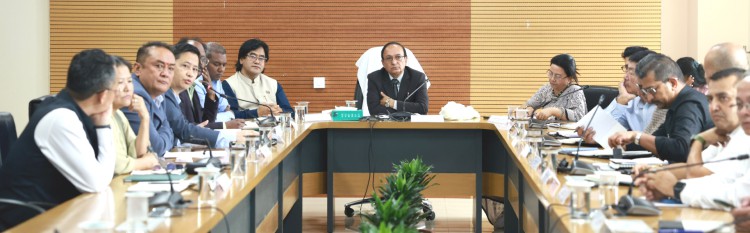
Members of the Institute for Transforming Sikkim (ITS), led by vice chairman C.P.
Sharma, held a consultative meeting with senior officials of the Forest,
Environment and Wildlife Management department today at the conference hall of
Tashiling Secretariat.
MLA
and advisor to Forest department, Tenzing Norbu Lamtha, in his address,
emphasised the importance of checks and balances and highlighted the need for
sustainability and proper maintenance of created assets, cautioning that
failure to maintain them could eventually turn them into liabilities.
Planning
and Development secretary Tushar Nikhare, in his welcome address, apprised the
gathering that the objective of holding a series of consultation meetings with
various departments is to discuss their respective visions for Viksit Sikkim
@2047 and gather inputs and suggestions from different departments.
Chief
Wildlife Warden and Chief Conservator of Forests (Environment/HQ) Dr. D.
Manjunatha, in his presentation, highlighted Sikkim’s rich biodiversity and the
importance of strengthening landscape-based conservation, climate resilience
and human-wildlife coexistence. He identified human-wildlife conflict, climate
change and habitat fragmentation as key challenges and outlined the five
strategic goals under the Sikkim Wildlife Sector Vision 2047, focusing on
biodiversity conservation, climate-resilient ecosystems, human-wildlife
coexistence, green livelihoods and smart wildlife governance.
He
further highlighted flagship programmes on wildlife connectivity,
human-wildlife conflict mitigation, red panda and high-altitude species
recovery, smart wildlife monitoring and the promotion of a green wildlife
economy. The Vision targets a 75 percent reduction in crop damage and livestock
losses and near-zero human fatalities by 2047, while strengthening community
participation and technology-enabled wildlife management.
Forest
additional director (Planning) Nischal Gautam, in his presentation, apprised
the gathering of the state’s initiatives and achievements in forest
conservation and biodiversity management.
He
highlighted that forest cover accounts for 47.33 percent of Sikkim’s
geographical area, representing an increase of approximately 17.37 sq. km
between 2021 and 2023, compared with the national average of 21.76 percent. He
further stated that 5,841 sq. km, or more than 82 percent of the state’s
geographical area, is classified as Recorded Forest Area (RFA), while an
additional 1,297.77 sq. km lies outside the RFA.
Despite
accounting for only around 0.2 percent of India’s geographical area, Sikkim
supports approximately 26 percent of the country’s biodiversity. The state also
has a Protected Area Network covering 30.77 percent of its geographical area,
the highest percentage of protected-area coverage among Indian states, compared
with the national average of approximately 5.3 percent.
Highlighting
significant achievements in wildlife conservation, Gautam noted the first
camera-trap capture of a snow leopard near Goru Jurey in Pangolakha Wildlife
Sanctuary at an elevation of 9,583 feet. Remarkably, the same location had
earlier yielded Sikkim’s first photographic record of a Royal Bengal Tiger on
December 6, 2018.
He
also highlighted the sighting of a rare and significant herd of Mishmi takin in
Sikkim in 2026, describing it as one of the largest documented sightings of the
species in the state in recent decades.
The
presentation also covered the department’s ex-situ conservation efforts and its
major awards and recognitions. Gautam elaborated on several key government
initiatives and programmes, including ‘Mero Rukh, Mero Santati’, Sikkim Shishu
Samriddhi Yojana, the ‘My Child from Wild’ initiative, revenue and policy
implementation measures, and efforts to promote rural livelihoods and enhance
farmers’ incomes through Pradhan Mantri Krishi Sinchayee Yojana – Watershed
Development Component 2.0 (PMKSY-WDC 2.0).
He
further briefed the gathering on the implementation of the Van (Sanrakshan Evam
Samvardhan) Adhiniyam, 1980 (VSSA, 1980), as well as the Nagar Van initiative.
Gautam
also outlined the State’s performance against Sustainable Development Goal
(SDG) indicators, while highlighting key challenges and the way forward. He
emphasised several critical areas requiring further strengthening to ensure the
sustainable management of the state’s forests, wildlife and natural resources.
Concluding
his presentation, he elaborated on the Government of Sikkim’s BiPaSa policy,
aimed at the development of three core infrastructure sectors—Bijuli
(electricity), Pani (drinking water) and Sadak (roads). He highlighted ‘Pa’ as
a key component and explained how initiatives such as Mission Million Oak,
Springshed Development, Pokhari Samrakshan and Roof Rainwater Harvesting contribute
towards achieving the policy’s objectives.
Presentations
were also made on the Territorial Circle; Forest Clearance Procedure as per the
Van (Sanrakshan Evam Samvardhan) Adhiniyam, 1980; Compensatory Afforestation
Fund Management and Planning Authority (CAMPA); Environment and Soil
Conservation Circle; Silviculture Circle; Working Plan Circle; Survey and
Demarcation Circle; and Research and Education Circle.
In
his concluding remarks, ITS member James Saring Lepcha provided his inputs and
suggestions to the department.
The
IT Cell of the department also showcased the forest.sikkim.gov.in website,
highlighting the department’s digital governance initiatives.
Earlier,
prior to the commencement of the meeting, Planning and Development sector expert
(Economics and Finance) Rosen Sharma apprised the gathering of the composition
and functioning of the Institute for Transforming Sikkim.
