


Tuesday, Feb 24, 2026 21:45 [IST]
Last Update: Monday, Feb 23, 2026 16:10 [IST]


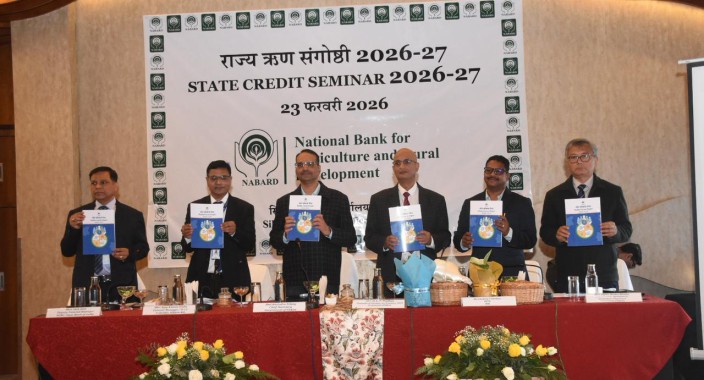
GANGTOK, (IPR): The State Credit Seminar 2026-27, organised by the Sikkim
Regional Office of the National Bank for Agriculture and Rural Development
(NABARD), was held Monday at a local hotel in Gangtok.
The
inaugural session of the seminar was attended by Chief Secretary, Government of
Sikkim, Ravindra Telang, as chief guest.
He
was accompanied by Controller of Accounts & Secretary, Finance department,
MCP Pradhan, commissioner-cum-secretary, Agriculture and Horticulture
department, Jigme Dorjee Bhutia, deputy general manager, Reserve Bank of India,
Rodney Valentine, deputy general manager, Local Head Office, Kolkata, State
Bank of India, Alok Jain, and general manager/officer in charge, NABARD Sikkim,
Ajay Kumar Sinha.
On
the occasion, the State Focus Paper (SFP) 2026-27, an annual credit planning
document prepared by NABARD for the State of Sikkim, was formally released.
The
document estimated the aggregate credit potential for 2026-27 assessed at Rs.
1701.42 crore, comprising Rs. 589.04 crore (34.62%) for agriculture and allied,
Rs. 968.99 crore (56.95%) for MSME and Rs.143.39 crore (8.43%) for other
priority sectors.
In
his keynote address, the Chief Secretary stressed the critical role of credit
in driving economic growth and human development. He described the State Focus
Paper as an important guiding document that would determine the credit outlay
for the coming financial year and shape the State’s developmental priorities.
Highlighting
the broader philosophy of credit, the Chief Secretary said that credit is
fundamentally built on trust and belief in a better future. He stated that when
credit flows adequately, it reflects society’s confidence in growth and
progress.
Conversely,
inadequate credit flow weakens economic motivation and limits entrepreneurial
aspirations, he added.
The
Chief Secretary stressed the importance of linking welfare initiatives with
credit-based growth models to encourage self-reliance and long-term economic
sustainability.
Thereafter,
he called upon banks, government departments, and other institutions to
collectively create an enabling environment where individuals feel confident in
accessing credit, investing productively and generating returns higher than
borrowing costs.
Referring
to agriculture and allied sectors, he highlighted the need for focused,
cluster-based development instead of fragmented and shifting approaches. He
stated that lack of consistency and collective action often dilutes economic
impact.
Emphasising
Sikkim’s unique strengths, he urged stakeholders to concentrate on high-value,
niche products where the state has a comparative advantage, rather than
competing in mass markets.
The
Chief Secretary also highlighted the importance of developing reliable market
linkages so that producers, including Self-Help Groups (SHGs), can scale up
their activities beyond exhibitions and limited local sales towards sustainable
income generation.
He
further expressed confidence that collective efforts by government
institutions, banks and development agencies would unlock the State’s untapped
potential and ensure more inclusive and meaningful economic growth.
In
his address, DGM, SBI Kolkata, Alok Jain, congratulated NABARD on the release
of the State Focus Paper 2026-27. He described the document as a comprehensive
roadmap for the state’s development, stating that it provides sector-wise
credit potential and serves as an important guide for banks in preparing the
Annual Credit Plan.
Highlighting
the significance of agriculture in the State’s economy, he encouraged banks to
support the transition from subsistence to commercial farming by promoting
improved practices, value addition and better market linkages.
He
underlined the importance of coordinated efforts to strengthen priority sector
lending and rural development, while reaffirming the banking sector’s
commitment to working closely with NABARD and the Government of Sikkim to
support inclusive and sustainable economic growth in the State.
Addressing
the gathering, commissioner-cum-secretary, Agriculture and Horticulture department,
Jigme Dorjee Bhutia, said that the State Credit Seminar is an important
platform for aligning financial support with the State’s developmental
priorities. He appreciated the efforts of NABARD in preparing the State Focus
Paper and termed it a key driver for sectoral growth, particularly in
agriculture and allied activities.
He
added that effective implementation of the credit plan would require close
coordination between stakeholders so that the document translates into tangible
outcomes on the ground.
Highlighting
ongoing initiatives in the agriculture sector, he spoke about the importance of
strengthening value addition, processing, branding and structured market
linkages to enhance farmers’ income. He stressed the need to move towards a
more organised and market-oriented agricultural ecosystem while ensuring that
small and marginal farmers remain adequately supported.
Bhutia
further underscored the importance of integrated development of agriculture
with allied sectors such as fisheries and animal husbandry, adding that a
holistic and inclusive credit approach would benefit the majority of farmers in
the State. He called for continued collaboration among stakeholders to improve
credit absorption, address challenges at the grassroots level and ensure that
financial support reaches intended beneficiaries in a timely and effective
manner.
Deputy
general manager, RBI, Rodney Valentine, in his brief address, highlighted the
significance of priority sector lending and urged banks to work towards
effective achievement of sectoral targets, particularly in agriculture and
allied activities, MSMEs and other priority segments. He also encouraged
greater credit outreach in districts with lower credit penetration.
Stressing
the need for stronger financial literacy and compliance, Valentine stressed the
importance of Know Your Customer (KYC) norms to ensure smoother access to
banking services and government schemes. He called for continued synergy among
all stakeholders to promote inclusive and sustainable growth in the State.
During
the course of the event, NABARD’s Sikkim Regional Office ceremonially handed
over sanction letters and disbursement support to partner institutions under
various initiatives through the hands of the Chief Secretary.
These
included direct financial assistance to Sikkim State Cooperative Bank Ltd to
strengthen and diversify its lending portfolio; support for Tribal Development
Fund project at Kitam Manpur GPU in Namchi district and Naga GPU in Mangan
district; incentives to promote customer service points and business
correspondents for expanding last-mile banking outreach; and assistance for
deployment of micro-ATMs to enhance digital financial inclusion through
cooperative institutions.
During
the technical session, a series of presentations were made highlighting key
development initiatives.
Deputy
general manager, NABARD, Anil Kumar Yadav, gave a comprehensive presentation on
the credit plan and projections under the State Focus Paper 2026-27.
Likewise,
the NABARD representative presented an overview of initiatives undertaken by
NABARD in the State, including interventions aimed at strengthening rural
infrastructure, financial inclusion and livelihood promotion.
A
presentation on Geographical Indications (GI) focused on NABARD’s efforts in
supporting GI-related interventions in Sikkim to enhance value addition,
branding and market linkage for local products.
Subsequently,
another presentation highlighted the status of cooperatives in the State and
elaborated on NABARD’s role in strengthening cooperative institutions and
promoting sustainable credit and institutional development.
Beneficiaries
of various NABARD-supported initiatives also shared their experiences during
the seminar.
Among
them, Ugen P. Lepcha presented the Geographical Indication (GI) certificates
granted by the Government of India for the traditional Lepcha musical instruments,
Tungbuk and Pumtong Pulit. He underscored the significance of GI recognition in
preserving indigenous heritage, ensuring legal protection, and enhancing the
identity and market value of these culturally significant instruments.
The
vote of thanks was proposed by AGM, NABARD, Tempa C Bhutia.
Earlier,
the welcome address was delivered by general manager/officer in charge, NABARD
Sikkim, Ajay Kumar Sinha.
